Governor Kathy Hochul announced on February 27, 2026, that the New York State Department of Health will distribute $10 million in funding to expand dental care services at 33 school-based health centers across New York State over five years.
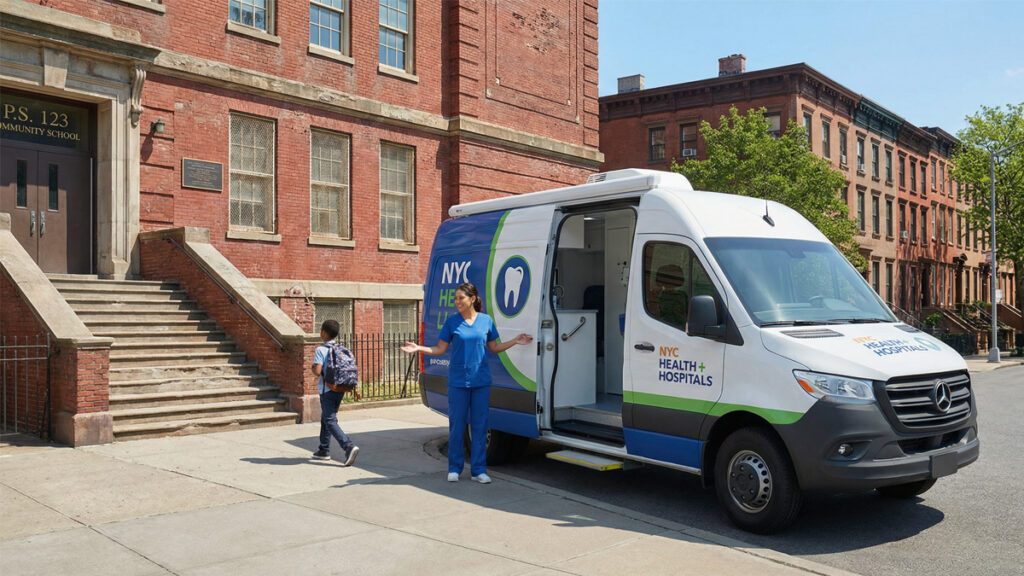
The program delivers free preventive and restorative dental care, including screenings, sealants, and treatments, directly inside schools through fixed clinics, mobile dental units, and portable setups.
Services are free to students regardless of insurance status, with funding specifically designed to cover costs that would otherwise be billed to families.
For parents in Queens struggling to find affordable pediatric dental care, this investment represents one of the most direct expansions of children’s oral health access in New York in years.
WHAT YOU NEED TO KNOW
- What happened: New York State announced $10 million to expand dental care at 33 school-based health centers statewide, announced February 27, 2026.
- What is covered: Dental screenings, sealants, and restorative treatments delivered free to students directly in school.
- Who qualifies: Students at schools with participating health centers. Services are free regardless of insurance status.
- Queens angle: NYC school-based health centers are among the eligible recipients. Parents should ask their child’s school whether it has applied for or received this funding.
- Who confirmed this: Office of Governor Kathy Hochul / New York State Department of Health, February 27, 2026.
New York’s $10 Million School Dental Investment: The Full Details
The New York State Department of Health is distributing $10 million across 33 school-based health centers over a five-year period.
This is not a one-time grant; it is a sustained investment designed to build lasting dental infrastructure inside schools.
According to the Governor’s office announcement, the funding is specifically structured to:
- Offset dental costs not covered by insurance that would otherwise be billed to families
- Cover staffing costs, including dental hygienist salaries
- Fund the purchase of equipment and supplies needed for dental operations
- Expand service capacity and reduce cost barriers in underserved communities
- Foster health equity by improving access for students in low-resource settings
Dental services are delivered through three delivery models: fixed dental sites located inside school buildings, mobile dental clinics brought onto school property, and portable dental setups in designated school spaces.
All three models are designed to meet children where they are, eliminating the transportation and scheduling barriers that keep many Queens families from keeping routine dental appointments.
To understand the full range of preventive services these programs typically offer, including dental sealants, our complete guide to cavities in children explains what each procedure does and why it matters for your child’s long-term oral health.
Grant recipients are required to report service delivery metrics to the state, including documentation of outcomes tied to sealants applied, screenings conducted, and treatments delivered.
This accountability structure ensures the funding reaches students rather than being absorbed by administrative costs.
Governor Hochul stated, "With this investment, we are meeting children where they are to provide dental services and set them on the path for a healthy life."
New York State Health Commissioner Dr. James McDonald added: "Practicing good oral hygiene, including routine brushing twice daily and flossing, and having access to preventive oral health care can prevent or reduce tooth decay in children and positively affect their overall health."
Why This Matters for Parents
Tooth decay is the most common chronic disease in children, more common than asthma, diabetes, or any other childhood condition.
Yet it is almost entirely preventable.
The problem is not a lack of knowledge about what prevents cavities; it is a lack of access to the care that provides that prevention.
School-based dental programs address this access gap directly.
Research consistently shows that school-based dental programs dramatically increase the number of children receiving preventive care.
Children who receive dental sealants through school programs are significantly less likely to develop cavities in their back molars, the teeth most vulnerable to decay, compared to children who rely solely on private dental visits.
Sealants are one of the most cost-effective interventions in all of pediatric medicine: the CDC estimates every dollar spent on dental sealants saves as much as $11 in future treatment costs.
For Queens families specifically, the significance of this program is hard to overstate.
Queens is home to one of the most ethnically and economically diverse populations in the United States, with a large share of children enrolled in Medicaid.
As we reported in our coverage of the national surge in children’s ER visits for tooth pain, only 1 in 3 US dentists accept Medicaid, making access to routine dental care extremely difficult for many Queens families, even when they technically have insurance.
A school-based program that is free regardless of insurance status removes that barrier entirely.
In 2024, Governor Hochul also signed legislation expanding access to fluoride treatments for pediatric dental patients, a complementary measure that increases the clinical protection children receive at each dental visit.
This $10 million investment builds on that foundation by expanding the physical infrastructure through which those treatments are delivered.
What Pediatric Dental Officials Are Saying
Assemblymember Amy Paulin, who has championed children’s health legislation in Albany, commented: “Access to quality dental care is essential to a child’s overall health and development.
I applaud Governor Hochul for investing in dental care at school-based health centers, which are a lifeline for children in low-income and underserved communities.”
The AAPD’s position, consistent across its policy documents, is that school-based dental programs are among the highest-impact interventions available for closing the oral health equity gap.
Children in low-income families are twice as likely to have untreated tooth decay compared to children in higher-income families.
School-based programs are the most efficient mechanism for reaching these children before decay becomes severe.
This is especially relevant at a moment when, as pediatric dentists have warned, proposed federal Medicaid cuts could further restrict dental access for millions of children beginning in late 2026.
What This Means for Your Child By Age Group
Elementary school children (ages 5–11): This age group benefits most directly from school dental programs. The first permanent molars erupt around age 6, and these teeth are the most cavity-prone teeth in the mouth.
Sealants applied to these molars within the first year of eruption provide up to 80 percent protection against cavities for several years.
If your child’s school health center is receiving this funding, getting sealants applied at school could protect your child’s most important teeth at no cost to your family.
Middle school children (ages 11–14): The second set of permanent molars erupts around age 12.
School dental programs that extend into middle school can provide sealants to these teeth as well, extending cavity protection through the highest-risk years of adolescence.
This is also the age when orthodontic concerns become more prominent.
Screenings at school-based health centers can flag issues early.
Our guide on what to expect at pediatric dental checkups by age explains what screenings typically cover at each stage of development.
All ages: Every child at a participating school benefits from dental screenings, which can identify cavities, gum disease, developmental issues, and other concerns that parents may not be aware of.
Early identification means simpler, less expensive treatment. A cavity caught during a school screening and treated promptly is a filling, not a crown or extraction.
How Queens Parents Can Find Out If Their Child’s School Is Participating
The New York State Department of Health has not yet published a public list of the 33 funded school-based health centers as of this writing.
To find out whether your child’s school is participating or plans to participate, take these steps:
First, contact your school’s main office or ask the school nurse whether the school has a health center and whether dental services are offered or planned.
Second, contact your local NYC Department of Education Community Education Council (CEC) in Queens, which has multiple CECs organized by district, and ask about the school health center dental program status.
Third, call NYC Health + Hospitals at 844-NYC-4NYC, which operates many of the school-based health centers in Queens and can confirm which locations are receiving dental program funding.
You can also browse our Queens pediatric dentist directory for private dental offices near your child’s school that accept Medicaid if school-based services are not yet available at your school.
Frequently Asked Questions About New York’s School Dental Program
Is the school dental program really free?
Yes. School-based health centers provide dental services free to students regardless of insurance status.
The $10 million in state funding is specifically designed to cover costs that would otherwise be billed to families or their insurance.
There are no out-of-pocket costs for children receiving care at participating school health centers.
What dental services are included in the program?
The program covers preventive and restorative dental care, including dental screenings (examinations), dental sealants to protect molars from cavities, and treatments for existing dental problems.
The specific services available at each school health center may vary based on the equipment and staffing at that location.
Does my child still need to see a private dentist if they get care at school?
School-based dental programs are an excellent supplement to private dental care but are not a complete replacement for a relationship with a regular pediatric dentist.
School programs typically focus on preventive care and basic restorative treatments.
Complex procedures, orthodontic evaluations, and emergency care still require a private dental provider.
The AAPD recommends children see a dentist every 6 months.
School programs can help fill gaps between private visits.
When will the school dental programs begin?
The funding was announced on February 27, 2026, and will be distributed over five years.
The timeline for individual school health centers to launch or expand dental services will vary.
Parents should contact their school’s health center directly to ask about the start date for dental services at their specific location.
Medical disclaimer: This article is for informational purposes only and does not constitute medical or dental advice. Always consult a licensed pediatric dentist for your child's specific dental health needs.
Reviewed by the Pediatric Dentist in Queens Editorial Team. Last Updated: March 14, 2026.
SOURCE LIST
1. Office of Governor Kathy Hochul — “Governor Hochul Announces $10 Million to Expand Access to Dental Care for Children.” February 27, 2026. https://www.governor.ny.gov/news/governor-hochul-announces-10-million-expand-access-dental-care-children
2. New York State Dental Association — Same announcement, NYSDA coverage. February 27, 2026. https://www.nysdental.org/news-publications/news/2026/02/27/governor-hochul-announces–10-million-to-expand-access-to-dental-care-for-children
3. WBNG News — “$10 million funds to support children’s dental care services in New York.” February 28, 2026. https://www.wbng.com/2026/02/28/10-million-funds-support-childrens-dental-care-services-new-york/
4. WGRZ Buffalo — “New York invests $10M in school-based dental care.” February 2026. https://www.wgrz.com/article/news/health/ny-allocates-10m-to-expand-child-dental-care/71-c18f966e-6f18-4f08-8949-0273048bd7f1
Mary – Queens Pediatric Dental Resource Manager. I’m a dental health researcher and parent advocate based in Queens, NY. After struggling to find reliable pediatric dental information during my own child’s dental emergency, I created this resource to help other Queens families navigate their children’s oral health needs.
I curate evidence-based information from leading pediatric dental organizations, peer-reviewed research, and trusted dental health experts. While I’m not a dentist, I’m committed to providing accurate, practical guidance that helps parents make informed decisions.
All content is thoroughly researched and includes proper medical disclaimers directing families to consult qualified pediatric dentists for their children’s specific needs.