Quick Answer
What children eat and drink directly impacts their dental health—often more than brushing habits alone. The best foods for teeth are those high in calcium (dairy, leafy greens), phosphorus (meat, eggs, nuts), and fiber (crunchy fruits and vegetables). The worst are sticky sweets, frequent sugary drinks, and acidic beverages that erode enamel. The timing and frequency of snacking matters as much as what’s eaten—constant grazing keeps teeth bathed in acid, preventing natural repair.
Key Takeaways
- ✓ Cavity-causing bacteria feed on sugars and starches, producing acid that attacks tooth enamel
- ✓ Frequency of sugar exposure matters more than total amount—constant snacking is worse than one treat
- ✓ Cheese, milk, and yogurt actively protect teeth by neutralizing acid and providing calcium
- ✓ Water is the best beverage for teeth; juice should be limited to 4-6 oz daily for young children
- ✓ Baby bottle tooth decay is 100% preventable—never put babies to bed with milk, juice, or formula
- ✓ Crunchy fruits and vegetables stimulate saliva, which naturally cleanses and protects teeth
How Diet Causes Cavities: The Science
Cavities don’t come from sugar directly—they come from acid produced when mouth bacteria feed on sugars and starches.
Understanding this process helps you make smarter food choices for your child’s dental health.
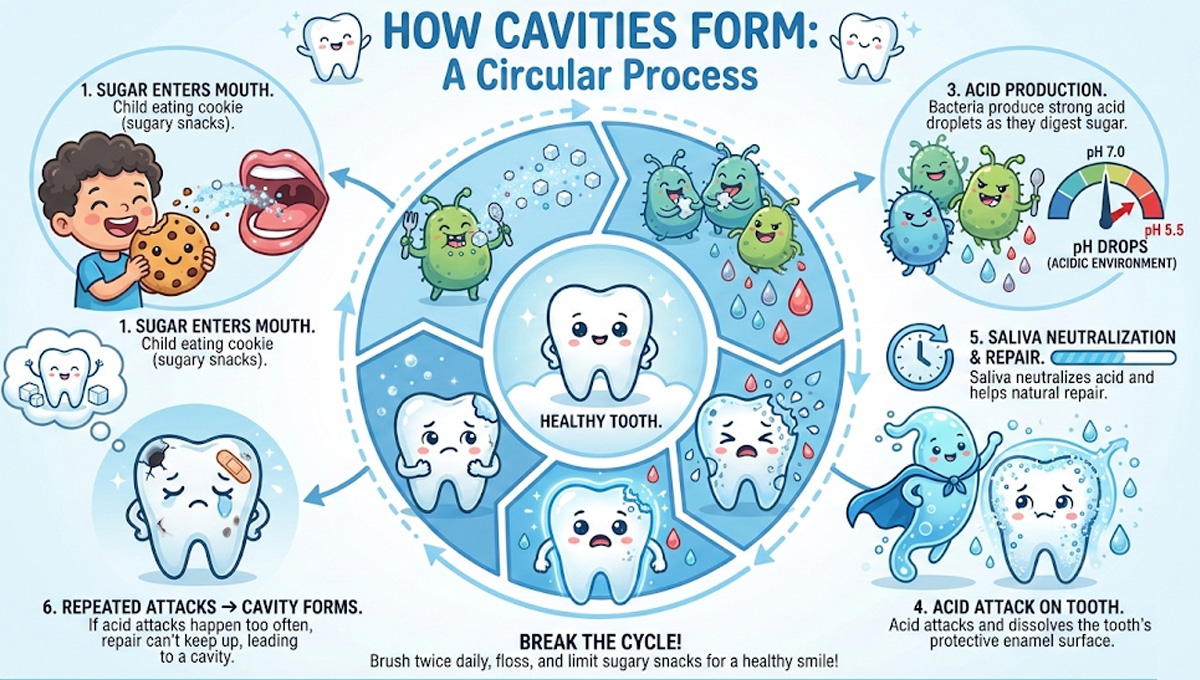
The Cavity Formation Process
- Your child eats or drinks something containing sugar or starch (carbohydrates)
- Bacteria naturally present in the mouth feed on these carbohydrates within minutes
- As bacteria digest the sugars, they produce acid as a byproduct
- The acid attacks tooth enamel (the hard outer layer), dissolving minerals in a process called demineralization
- Saliva naturally neutralizes acid and repairs enamel (remineralization)—but this takes 20-30 minutes
- If acid attacks happen faster than repair can occur (frequent snacking/sipping), permanent damage occurs
- Over time, weakened enamel breaks down, forming a cavity (hole in the tooth)
Why Frequency Matters More Than Amount
This is the single most important nutrition concept for dental health: Every time your child eats or drinks something containing carbohydrates, their teeth experience an “acid attack” lasting about 20-30 minutes.
According to the American Academy of Pediatric Dentistry, the frequency of these attacks matters more than the total amount of sugar consumed.
Consider this comparison:
- Child A: Drinks one glass of juice with lunch → 1 acid attack
- Child B: Sips the same juice throughout the afternoon over 2 hours → Continuous acid attack for 2+ hours
Child B has far higher cavity risk despite consuming the same amount of juice. Their teeth never get a break to repair.
Best Foods for Children’s Teeth
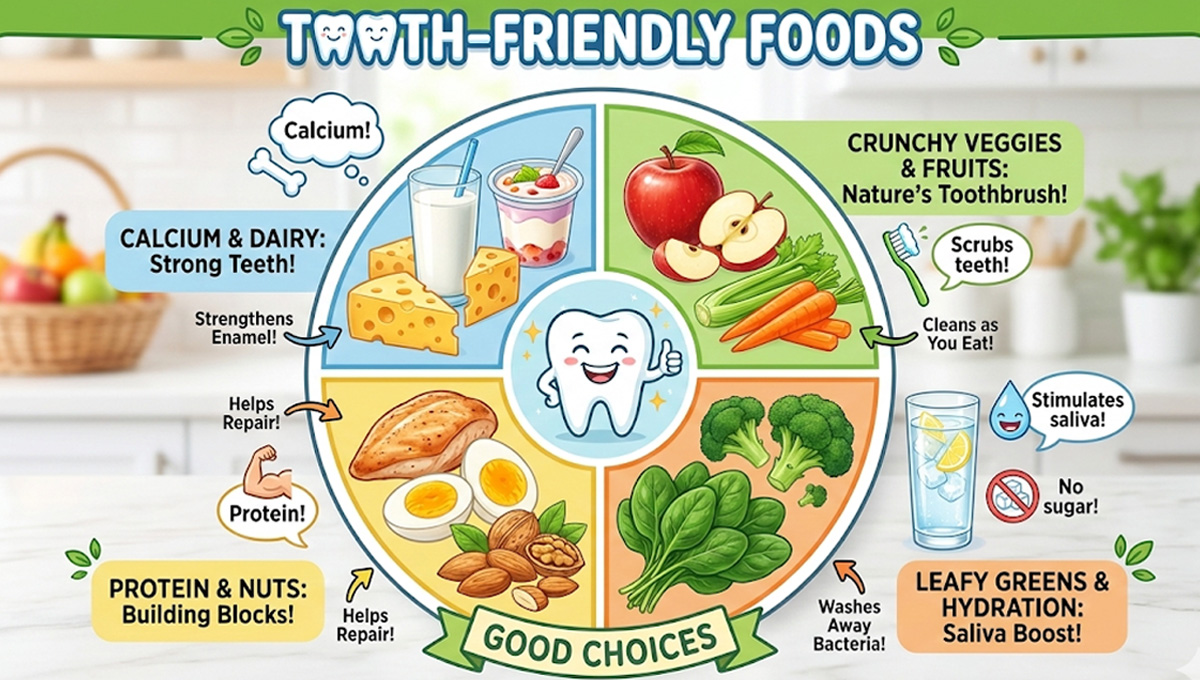
Some foods actively protect teeth by providing minerals for strong enamel, stimulating saliva flow, or neutralizing acid.
The American Dental Association highlights these tooth-friendly food categories:
🧀 Dairy Products
Dairy is a dental superfood. Cheese, milk, and yogurt:
- Provide calcium and phosphorus—the building blocks of tooth enamel
- Contain casein protein—which strengthens and repairs enamel
- Stimulate saliva production—which washes away food and neutralizes acid
- Neutralize mouth acid directly—cheese in particular raises mouth pH quickly
Best choices: Cheese (especially aged varieties like cheddar), plain yogurt, milk. Avoid sweetened yogurts and flavored milks, which contain added sugars.
🥕 Crunchy Fruits and Vegetables
Nature’s toothbrushes. High-fiber, crunchy produce:
- Stimulate saliva flow—the mouth’s natural cleaning and buffering system
- Scrub tooth surfaces—the fibrous texture mechanically cleans while chewing
- Require more chewing time—increasing saliva production
- Contain high water content—diluting natural sugars
Best choices: Apples, carrots, celery, cucumbers, bell peppers, pears. Serve raw when possible for maximum benefit.
🥩 Protein Foods
Protein-rich foods provide phosphorus—essential for strong teeth—without feeding cavity-causing bacteria:
- Meat, poultry, fish: High in phosphorus and protein; don’t contribute to decay
- Eggs: Excellent source of protein, vitamin D, and phosphorus
- Nuts and seeds: Contain calcium, phosphorus, and healthy fats; require chewing
- Beans and legumes: Good protein and fiber; no added sugars
🥬 Leafy Greens
Spinach, kale, and other leafy greens are rich in calcium, folic acid, and B vitamins that support gum health.
They’re also high in fiber and require chewing, promoting saliva flow.
| Food Category | Best Choices | Why It’s Good |
|---|---|---|
| Dairy | Cheese, plain yogurt, milk | Calcium, phosphorus, neutralizes acid |
| Crunchy vegetables | Carrots, celery, cucumber, bell peppers | Stimulates saliva, scrubs teeth, high fiber |
| Crunchy fruits | Apples, pears | High water content, fiber, stimulates saliva |
| Nuts and seeds | Almonds, cashews, sunflower seeds | Calcium, phosphorus, requires chewing |
| Lean proteins | Chicken, fish, eggs, beans | Phosphorus, doesn’t feed bacteria |
| Leafy greens | Spinach, kale, lettuce | Calcium, vitamins, high fiber |
| Water | Plain water (especially fluoridated) | Rinses mouth, no sugar, fluoride strengthens enamel |
Worst Foods for Children’s Teeth
Some foods are particularly damaging to teeth due to their sugar content, stickiness, acidity, or how they’re consumed.
Limiting (not necessarily eliminating) these foods significantly reduces cavity risk.
🍬 Sticky, Chewy Sweets
The worst of the worst. These stick to teeth and between teeth, prolonging sugar exposure and acid attacks:
- Gummy candy, fruit snacks, gummy vitamins
- Caramels, taffy, toffee
- Dried fruit (raisins, dates, dried apricots)—often worse than candy
- Fruit leather, fruit roll-ups
- Jelly beans, licorice
🍭 Hard Candies and Lollipops
Slow-dissolving = extended acid attack. Sucking on hard candy bathes teeth in sugar for prolonged periods. Additionally, biting hard candies can crack or chip teeth.
🥤 Soda and Sugary Drinks
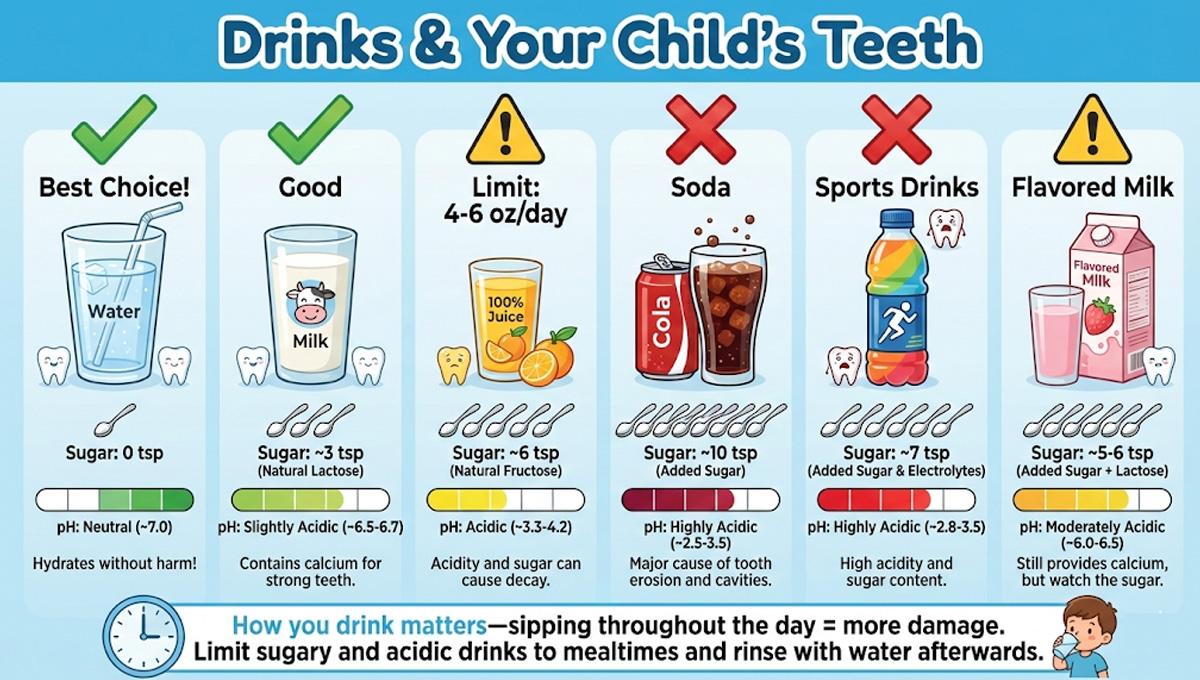
A double threat: High in sugar AND highly acidic. Regular soda contains approximately 10 teaspoons of sugar per 12-ounce can. Diet sodas, while sugar-free, are still acidic and erode enamel.
🍞 Starchy, Refined Carbohydrates
Often overlooked cavity culprits. Starches break down into sugars and can be sticky:
- Chips, crackers, pretzels
- White bread, especially soft sandwich bread
- Sugary breakfast cereals
- Goldfish crackers, graham crackers
🍋 Acidic Foods and Drinks
Acid directly erodes enamel without bacteria involvement:
- Citrus fruits and juices (in excess)
- Sports drinks
- Energy drinks
- Sour candies (extremely acidic)
- Vinegar-based foods
| Food/Drink | Why It’s Bad | Better Alternative |
|---|---|---|
| Fruit snacks/gummies | Extremely sticky; clings to teeth for hours | Fresh fruit; cheese cubes |
| Raisins/dried fruit | Sticky, concentrated sugar; sticks in grooves | Fresh grapes; apple slices |
| Soda (regular) | High sugar + high acid = double damage | Water; milk; diluted juice (occasional) |
| Sports drinks | High sugar + acidic; often sipped over time | Water (even during sports) |
| Hard/chewy candy | Prolonged sugar exposure; can crack teeth | Sugar-free gum with xylitol |
| Chips/crackers | Starches break down to sugar; get stuck in teeth | Vegetables with hummus; cheese |
| Sour candy | Extremely acidic (pH near battery acid) | Avoid completely; dark chocolate (occasional) |
Clinical Insight
“When I see a child with multiple new cavities, the first question I ask parents isn’t ‘How often does your child brush?’ It’s ‘What does your child snack on during the day?’ Nine times out of ten, there’s a pattern of frequent grazing or sipping on something sweet. I had a patient whose parents couldn’t understand why she had cavities—she ate very little candy. But she drank diluted apple juice all day from a sippy cup. That constant sugar exposure was causing more damage than a daily dessert would. Once we switched to water between meals, her cavity rate dropped to zero.”
— Mary G. Trice
Beverages: The Good, The Bad, and The Ugly
What children drink has an enormous impact on dental health—often more than food.
Beverages can be sipped throughout the day, creating constant sugar and acid exposure.
💧 Water: The Best Choice
Plain water is the best beverage for teeth. It:
- Contains no sugar or acid
- Rinses away food particles and bacteria
- Helps maintain saliva production
- If fluoridated, strengthens tooth enamel
🥛 Milk: Second Best
Plain milk is excellent for teeth—it contains calcium, phosphorus, and casein protein that protect enamel. However:
- Milk does contain natural lactose (sugar)—don’t let children sleep with milk bottles
- Chocolate milk and flavored milks have added sugars—treat as occasional treats
- Best consumed with meals rather than sipped throughout the day
🧃 Juice: More Problematic Than Most Parents Realize
Even 100% fruit juice with no added sugar is high in natural sugars and acid.
The American Academy of Pediatrics provides these guidelines:
| Age | Maximum Daily Juice | Notes |
|---|---|---|
| Under 12 months | 0 (none) | No juice at all; breast milk, formula, or water only |
| Ages 1-3 | 4 oz (1/2 cup) max | Serve in a cup, not bottle; with meals only |
| Ages 4-6 | 4-6 oz (1/2-3/4 cup) max | Fresh fruit is always better than juice |
| Ages 7-18 | 8 oz (1 cup) max | Encourage whole fruit instead |
🥤 Beverages to Limit or Avoid
- Soda (regular): High sugar + high acid = maximum damage. One 12-oz can has ~10 tsp sugar.
- Diet soda: No sugar, but still very acidic—erodes enamel.
- Sports drinks: High sugar and acid; marketed as “healthy” but terrible for teeth. Water is better even during sports.
- Energy drinks: Extremely high acid and sugar; also inappropriate for children due to caffeine.
- Sweetened tea/lemonade: Sugar-sweetened beverages with no nutritional benefit.
- Flavored waters: Check labels—many contain sugar or citric acid.
Sugar Guidelines for Children
The CDC and American Heart Association recommend strict limits on added sugars for children:
- Under age 2: Zero added sugars (none at all)
- Ages 2-18: Less than 25 grams (6 teaspoons) of added sugar per day
- Sugar-sweetened beverages: No more than 8 oz per week
For perspective, here’s how quickly children can exceed the 25-gram daily limit:
- 1 cup of sweetened cereal: 10-15g sugar
- 1 flavored yogurt cup: 12-20g sugar
- 1 juice box: 20-25g sugar
- 1 can of soda: 39g sugar (already over daily limit!)
- 1 packet of fruit snacks: 11g sugar
Hidden Sugars to Watch For
Sugar goes by many names on ingredient labels:
Common sugar aliases: High fructose corn syrup, sucrose, dextrose, fructose, glucose, maltose, cane sugar, brown sugar, raw sugar, honey, maple syrup, agave, fruit juice concentrate, molasses, corn sweetener
Smart Snacking Strategies
How and when children snack matters as much as what they snack on.
These strategies minimize cavity risk while still allowing treats:
Golden Rules for Tooth-Friendly Snacking
- Limit eating to defined meal and snack times. 3 meals + 2 planned snacks is ideal. Constant grazing keeps teeth under constant acid attack.
- Drink water between meals. If your child needs a drink between meals, make it water—not juice, milk, or anything sweetened.
- Pair sweets with meals. If your child has a treat, serve it with a meal when saliva production is highest and they’ll be brushing soon after.
- End meals with tooth-friendly foods. A piece of cheese or crunchy vegetables after a meal helps neutralize acid and clean teeth.
- Avoid bedtime snacks after brushing. Saliva flow decreases during sleep, reducing the mouth’s natural defense against acid.
- Choose whole foods over processed. An apple is better than apple juice; orange slices are better than orange-flavored snacks.
- Read labels. Many foods marketed to children (granola bars, yogurt tubes, fruit snacks) are essentially candy.
Tooth-Friendly Snack Ideas
Quick & Easy
- Cheese cubes or string cheese
- Apple slices with nut butter
- Carrot sticks with hummus
- Plain yogurt with berries
- Hard-boiled eggs
Fun Options
- Cucumber “sandwiches” with cream cheese
- Cheese and crackers (whole grain)
- Ants on a log (celery + nut butter + raisins—occasional)
- Veggie faces (arrange veggies on plate)
- Fruit kabobs with cheese cubes
Preventing Baby Bottle Tooth Decay
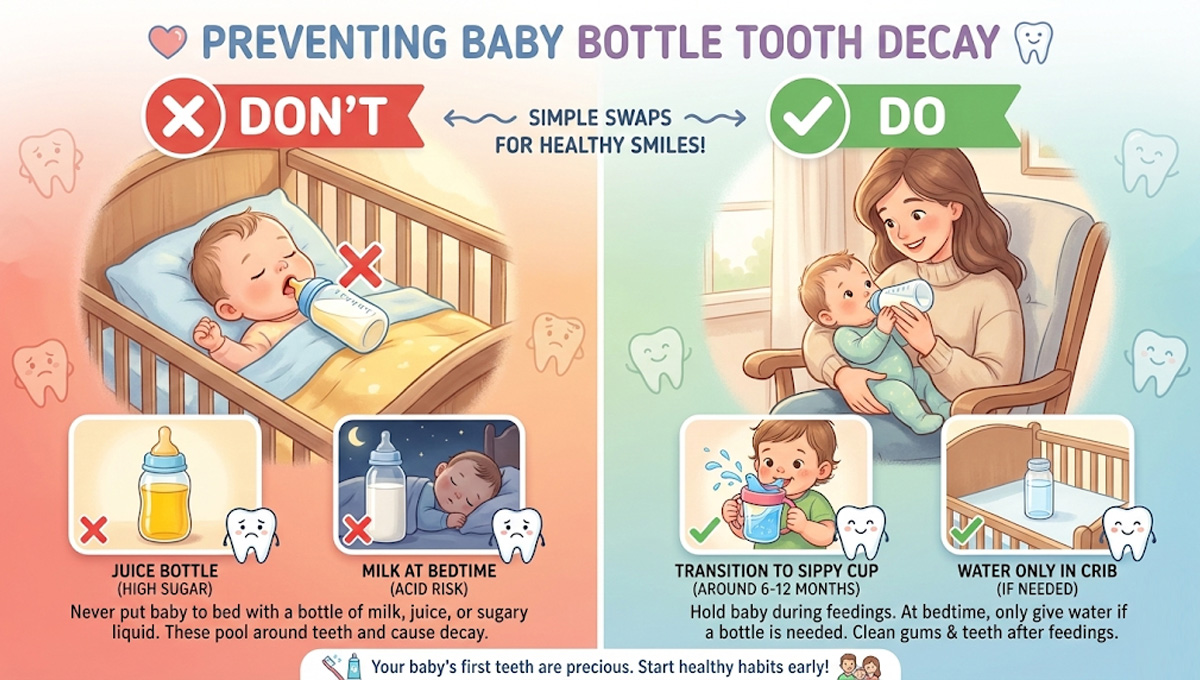
Baby bottle tooth decay (also called early childhood caries or nursing caries) is severe decay in infants and toddlers caused by prolonged exposure to sugary liquids—including breast milk, formula, and juice.
It’s most common in the upper front teeth and can be devastating.
How Baby Bottle Decay Happens
When a baby falls asleep with a bottle of milk, formula, or juice:
- The liquid pools around the upper front teeth
- Saliva production drops during sleep, so natural cleaning doesn’t occur
- Bacteria feed on the sugars for hours while the baby sleeps
- Acid attacks continue all night without interruption
- Over weeks and months, severe decay develops—sometimes destroying teeth completely
Prevention Rules
- Never put baby to bed with a bottle containing anything but water
- Don’t let baby use bottle as a pacifier or carry it around throughout the day
- Begin transitioning to a cup at 6 months; wean from bottle by 12-14 months
- Clean baby’s gums with a soft cloth after feeding, even before teeth appear
- Once teeth appear, brush twice daily with a rice-grain smear of fluoride toothpaste
- First dental visit by age 1—the dentist can spot early signs and provide guidance
- Avoid transferring bacteria: Don’t share utensils or “clean” pacifiers with your mouth
Clinical Insight
“Baby bottle decay is one of the most heartbreaking things I see because it’s 100% preventable. I’ve had to extract all four front teeth from toddlers who were otherwise healthy—and then watch those families deal with years of speech problems and self-consciousness until the permanent teeth came in. The culprit is almost always a bedtime bottle. I know it’s hard to break that habit—I’m a parent too—but the alternative is so much harder. If your baby needs comfort to fall asleep, try a pacifier (without honey or anything sweet on it), or a bottle of plain water.”
— Mary G. Trice
Vitamins and Minerals for Strong Teeth
Proper nutrition during tooth development (in utero through adolescence) affects tooth strength for life.
Here are the key nutrients for dental health:
| Nutrient | Role in Dental Health | Food Sources |
|---|---|---|
| Calcium | Primary building block of tooth enamel and bone; strengthens jaw | Dairy, fortified plant milks, leafy greens, canned fish with bones |
| Phosphorus | Works with calcium to build and protect enamel | Meat, poultry, fish, eggs, dairy, nuts, beans |
| Vitamin D | Essential for calcium absorption; deficiency linked to tooth defects | Sunlight, fortified milk, fatty fish, egg yolks |
| Vitamin C | Supports gum health; helps with collagen production | Citrus fruits, strawberries, bell peppers, broccoli |
| Vitamin A | Important for tooth development and saliva production | Sweet potatoes, carrots, leafy greens, eggs, liver |
| Fluoride | Strengthens enamel; helps remineralization; prevents decay | Fluoridated water, toothpaste, professional treatments |
Note about gummy vitamins: While vitamins are important, gummy vitamins are sticky and sugary—treating them as candy is appropriate. If your child takes gummy vitamins, give them with a meal and make sure teeth are brushed afterward. Chewable or liquid vitamins may be better choices for dental health.
Tooth-Friendly Lunchbox Ideas
Packing a tooth-friendly lunch doesn’t mean sacrificing taste or convenience.
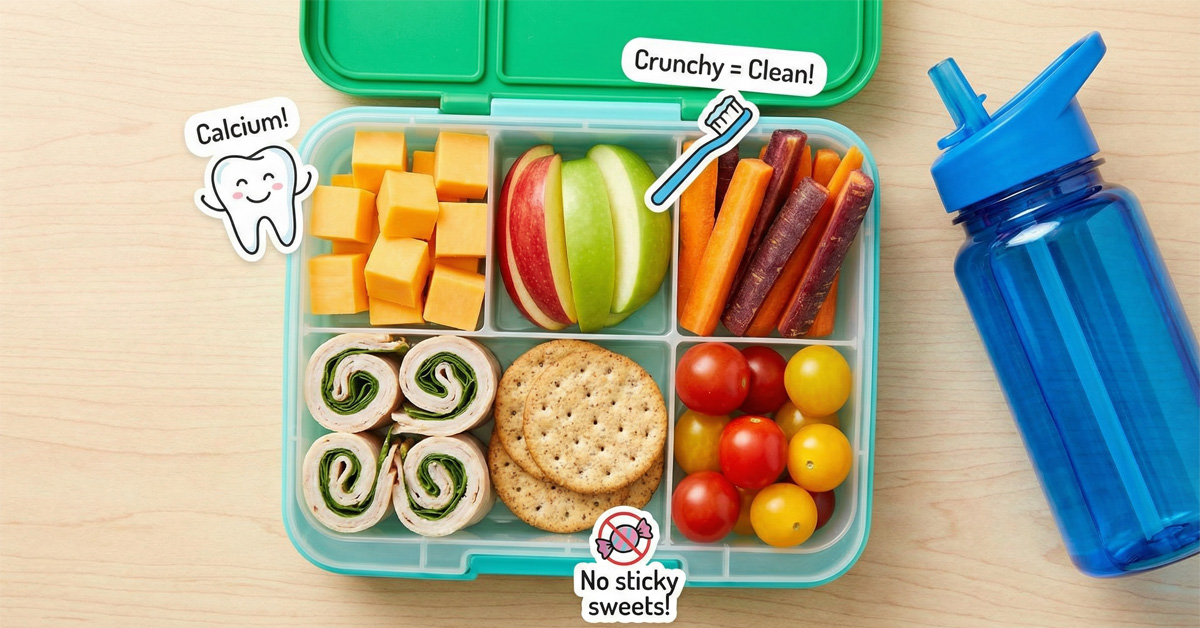
Here are complete lunch ideas that support dental health:
🥪 Lunch Option 1
- Turkey and cheese roll-ups
- Carrot sticks and cucumber slices
- Apple slices
- Water bottle
🥗 Lunch Option 2
- Whole grain crackers with cheese
- Hard-boiled egg
- Cherry tomatoes
- Pear slices
🍱 Lunch Option 3
- Hummus with veggie dippers
- Cheese cubes
- Whole grain pita
- Strawberries
🥙 Lunch Option 4
- Chicken salad lettuce wraps
- Bell pepper strips
- String cheese
- Cantaloupe cubes
Lunchbox Swaps
| Instead of… | Try… |
|---|---|
| Juice box | Water bottle (add lemon slice for fun) |
| Fruit snacks | Fresh fruit or cheese cubes |
| Chips | Veggie sticks with dip or popcorn (plain) |
| Sweetened yogurt tube | Plain Greek yogurt with fresh berries |
| Granola bar | Cheese and whole grain crackers |
| Chocolate milk | Plain milk or water |
Frequently Asked Questions
Is fruit bad for teeth because it contains sugar?
Whole fruit is generally fine and healthy. While fruit does contain natural sugars, it also has fiber, water, and vitamins that benefit overall health.
The fiber and water content dilute the sugars and stimulate saliva.
Problems arise with dried fruit (concentrated sugar, sticky texture) and fruit juice (concentrated sugar without fiber).
Stick to whole, fresh fruit as part of meals or snacks, and limit dried fruit and juice.
Are sugar-free candies and drinks safe for teeth?
Sugar-free products don’t feed cavity-causing bacteria, so they’re better than sugar-containing alternatives.
However, many sugar-free candies and drinks are still acidic and can erode enamel.
Sugar-free gum sweetened with xylitol is actually beneficial—xylitol inhibits bacteria and stimulates saliva.
For drinks, water is still the best choice; diet sodas are acid-free sugar but still highly acidic.
Can I give my baby juice if I water it down?
The AAP recommends no juice at all for babies under 12 months.
Watered-down juice is still juice—it still contains sugars and acid. For babies, breast milk, formula, and water (for babies over 6 months) are the only appropriate beverages.
After age 1, if you do give juice, limit it to 4 oz daily, serve in a cup (not bottle or sippy), and offer only at mealtimes—not throughout the day.
My child is a picky eater and won’t eat vegetables. What can I do?
Focus on what they will eat from the tooth-friendly list. If they like cheese, dairy is excellent for teeth.
If they’ll eat fruit, choose crunchy options like apples and pears. Keep offering vegetables without pressure—it can take 10-15 exposures before a child accepts a new food.
Make foods fun (veggie faces, dipping sauces) and model healthy eating yourself.
Prioritize eliminating the worst offenders (sugary drinks, sticky snacks) over forcing specific healthy foods.
Does milk at bedtime cause cavities?
Milk contains lactose (milk sugar), so yes, milk pooling around teeth overnight can contribute to cavities—this is a main cause of baby bottle tooth decay.
However, a glass of milk with dinner followed by tooth brushing is fine. The problem is milk in a bottle or cup that the child sips while falling asleep.
After brushing teeth, only water should be consumed until morning.
Are crackers really bad for teeth? They don’t taste sweet.
Yes, crackers can be surprisingly bad for teeth.
Starches break down into sugars through saliva enzymes, and crackers tend to get packed into the grooves of teeth where they feed bacteria for extended periods.
Goldfish, graham crackers, and similar snacks are common cavity contributors.
They’re not as bad as sticky candy, but they’re worse than many parents realize.
Pair crackers with cheese (which neutralizes acid) and offer water to rinse.
Should my child brush after every meal?
Brushing twice daily (morning and before bed) is the minimum recommendation.
Brushing after meals is beneficial but not always practical.
If brushing isn’t possible after meals or snacks, have your child rinse with water, chew sugar-free gum with xylitol, or eat a piece of cheese to help neutralize acid.
Wait 30 minutes after acidic foods before brushing—brushing while enamel is softened from acid can cause damage.
Sources & References
- American Academy of Pediatric Dentistry. (2024). Policy on Dietary Recommendations for Infants, Children, and Adolescents. AAPD Reference Manual. https://www.aapd.org
- American Dental Association. (2024). Nutrition and Oral Health. ADA.org. https://www.ada.org
- American Academy of Pediatrics. (2017). Fruit Juice in Infants, Children, and Adolescents. Pediatrics. https://publications.aap.org
- Centers for Disease Control and Prevention. (2024). Added Sugars. https://www.cdc.gov
Medical Disclaimer
This article provides general nutrition information for dental health and is not a substitute for professional dietary or dental advice. Individual needs vary based on age, health conditions, and other factors. Consult with your pediatric dentist and pediatrician for personalized guidance. Information current as of January 2026.

Mary – Queens Pediatric Dental Resource Manager. I’m a dental health researcher and parent advocate based in Queens, NY. After struggling to find reliable pediatric dental information during my own child’s dental emergency, I created this resource to help other Queens families navigate their children’s oral health needs.
I curate evidence-based information from leading pediatric dental organizations, peer-reviewed research, and trusted dental health experts. While I’m not a dentist, I’m committed to providing accurate, practical guidance that helps parents make informed decisions.
All content is thoroughly researched and includes proper medical disclaimers directing families to consult qualified pediatric dentists for their children’s specific needs.