Reviewed by our dental health editorial team. Last Updated: March 2026.
Quick Answer: The FDA’s October 2025 warning restricted ingestible fluoride supplements — not toothpaste, not drinking water. New York City still fluoridates its water at the CDC-recommended level. A Harvard study found a nationwide ban would create 25.4 million additional cavities in children within five years. The ADA, AAPD, and AAP all continue recommending fluoride toothpaste starting at the first tooth. Nothing about your child’s brushing routine needs to change.
You have probably seen the headlines. The FDA restricted fluoride supplements for children.
Utah and Florida banned fluoride from public drinking water.
RFK Jr. is calling it poison. Meanwhile, your child’s dentist is still recommending fluoride toothpaste.
And you are standing in the toothpaste aisle wondering if everything you thought you knew was wrong.
Here is the direct answer: fluoride toothpaste is not affected by any of these changes.
The FDA warning was specifically about prescription tablets and drops that children swallow — not toothpaste, not varnish, not the fluoride treatment at the dentist’s office.
A Harvard study published in JAMA Health Forum found that eliminating fluoride from public water would cause 25.4 million additional cavities in American children within five years.
This article explains exactly what changed, what did not change, and what you should do based on your child’s age and where you live.
For a deeper background on how fluoride works, see our guide on the role of fluoride in pediatric dental health.
Key Takeaways
- FDA warning is about supplements only: The October 31, 2025 FDA action restricts ingestible fluoride tablets and drops for children under 3 or at low cavity risk. It does not apply to toothpaste, fluoride varnish, or in-office treatments.
- New York City water is still safe: NYC continues to fluoridate at the recommended 0.7 mg/L. Only Utah and Florida have banned water fluoridation as of March 2026.
- Fluoride toothpaste remains the standard: The ADA, AAPD, and AAP all continue to recommend fluoride toothpaste starting at the first tooth. No professional dental organization has changed this guidance.
- The cavity math is alarming: A 2025 Harvard study found a full fluoride ban would create 25.4 million additional decayed teeth in children within five years — one extra cavity for every three children in the US.
- What actually changed for your child: If your child drinks NYC tap water and uses fluoride toothpaste, nothing about their cavity prevention plan needs to change right now.
Why Is the Fluoride Debate Trending Right Now?
The fluoride debate exploded in early 2025 when Health Secretary Robert F. Kennedy Jr. directed the CDC to stop recommending water fluoridation and announced plans to review fluoride supplements.
In May 2025, the FDA began the process of removing ingestible fluoride prescription products from the market.
On October 31, 2025, the agency issued its formal warning.
Utah and Florida passed legislation banning fluoride from public water systems.
Social media amplified the panic.
Anti-fluoride posts claiming fluoride lowers children’s IQ reached millions of views, with some X posts hitting 2.8 million views and more than 60,000 likes.
Parents in r/Parenting, r/Mommit, and r/beyondthebump posted hundreds of threads asking whether to switch to fluoride-free toothpaste and whether tap water is now unsafe for their babies.
The concern is real and worth addressing directly.
What Exactly Did the FDA Restrict — And Does It Affect Toothpaste?
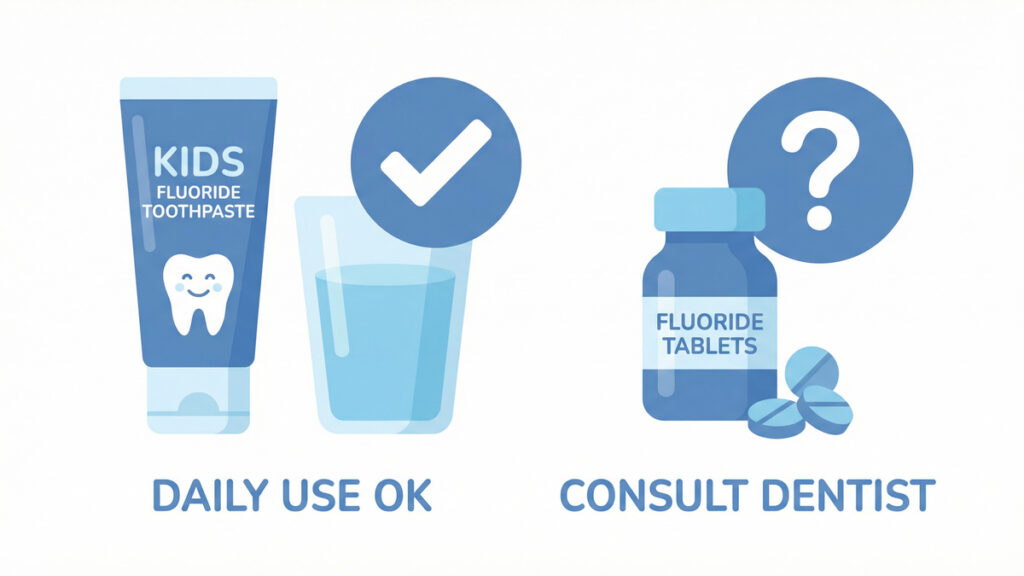
The FDA’s October 31, 2025 action applies only to ingestible fluoride prescription drug products — specifically fluoride tablets, drops, and lozenges that children swallow.
The agency recommended these products should not be given to children under age 3 or to older children at low or moderate risk of tooth decay.
The FDA did not restrict fluoride toothpaste.
It did not restrict fluoride varnish applied at dental visits. It did not restrict fluoride in drinking water at the federal level.
In its own letter to healthcare providers, the FDA specifically recommended “daily brushing with a fluoride toothpaste” as an effective method to prevent tooth decay.
This distinction matters enormously for parents. Fluoride toothpaste works differently from a supplement — it acts topically on the tooth surface rather than being absorbed into the body.
The ADA, AAPD, and AAP all reaffirmed their recommendations that fluoride toothpaste remains the first line of cavity prevention for children of all ages.
“A doctor’s clinical judgment, not a new warning label, should remain the guiding factor in determining appropriate fluoride use for children.” — Dr. Richard J. Rosato, D.M.D., President, American Dental Association, October 31, 2025
The FDA warning affects a narrow category of prescription products that most children were not receiving in the first place.
For most families in Queens and New York City, nothing about daily dental care changes.
Is Fluoride in Tap Water Still Safe for My Child?
For families in Queens and New York City, the answer is yes. New York City continues to fluoridate its public water supply at 0.7 milligrams per liter — the level recommended by the CDC and supported by 80 years of research.
The state of New York has made no moves to follow Utah or Florida.
As of March 2026, only two states — Utah and Florida — have banned the addition of fluoride to public drinking water.
Every other state continues to fluoridate according to federal guidelines.
About 60 percent of the US population, or more than 210 million Americans, receives fluoridated water, according to a 2022 CDC analysis covering 17,000 of the country’s 51,000 community water systems.
The IQ concern driving much of the anti-fluoride movement is based primarily on studies conducted in countries where fluoride levels in water are two to ten times higher than the 0.7 mg/L used in the US.
The Harvard JAMA Health Forum study, which used data from 8,484 American children, explicitly did not model negative cognitive effects because, the authors wrote, current US fluoride levels “are not definitively associated with worse neurobehavioral outcomes.”
Real-world evidence makes the stakes clear.
The city of Calgary, Canada removed fluoride from its water in 2011. Dental disease in children rose steadily for 14 years.
Calgary reintroduced fluoride in March 2025. Closer to home, Buffalo, New York went nine years without fluoride in its supply and saw a dramatic increase in cavities before fluoride was restored.
If you have well water or live in a recently defluoridated area, ask your pediatric dentist about your child’s fluoride exposure at the next visit.
Use our first dental visit guide to prepare for that conversation.
Will My Child Get More Cavities Without Fluoride Supplements?
For most children in NYC, no — because supplements were never the primary source of fluoride protection.
Supplements were specifically recommended only for children who drink non-fluoridated water and are at high risk of cavities.
If your child drinks NYC tap water and brushes with fluoride toothpaste, they were likely never a candidate for supplements in the first place.
But the national picture is different.
A 2025 Harvard School of Dental Medicine study published in JAMA Health Forum used data from 8,484 children ages 0 to 19 to model what would happen if all 50 states stopped fluoridating water.
Removing fluoride was associated with a 7.5 percentage point increase in tooth decay — 25.4 million additional decayed teeth within five years at a cost of $9.8 billion.
Within ten years, that number would reach 53.8 million additional decayed teeth at a cost of $19.4 billion.
“We know that the people who have the most benefit from fluoride are people who otherwise struggle to access dental care. When we think about those 25 million decayed teeth, they’re much more likely to appear in the mouths of children who are publicly insured by Medicaid or come from otherwise low-income households.” — Dr. Lisa Simon, Brigham and Women’s Hospital and Harvard Medical School, co-author of the JAMA study
The ADA credits water fluoridation with reducing tooth decay by more than 25 percent in children and adults over the past eight decades.
Fluoride supplements are still available for children over age 3 who are at high risk.
The American Academy of Pediatrics stated it “will continue to recommend fluoride supplements at age 6 months in non-fluoridated water communities.”
The FDA warning did not eliminate supplements — it restricted their use to the children who genuinely need them.
What Do Pediatric Dentists and the AAPD Actually Recommend?
The American Academy of Pediatric Dentistry, American Dental Association, and American Academy of Pediatrics have been consistent: the FDA warning does not change the core guidance for children’s dental health.
All three organizations continue to recommend:
- Fluoride toothpaste starting at the eruption of the first tooth
- Fluoride varnish applied by a dentist twice per year for children at elevated risk
- Fluoride supplements only for children at high caries risk who lack access to fluoridated water
The AAPD issued a pointed response to the FDA action, calling it “part of a broader effort to weaken preventive fluoride treatments in water, supplements, and toothpaste” and warning that “collectively, these efforts will have a drastic effect on caries prevention, and we will experience a rise in tooth decay.”
Dr. Paul Casamassimo, Chief Policy Officer of the AAPD, described the supplement restriction to NPR as removing “a choice” that clinicians need to protect their highest-risk patients. “
It would ban a treatment that is in the best interest of a patient, as determined by a trained, licensed health professional,” he said.
You can learn more about how cavities form and how to prevent them at all ages in our complete guide to cavities in children.
What Should Parents Do Right Now?
Under age 2: Use a smear of fluoride toothpaste the size of a grain of rice starting at the first tooth. Do not wait until age 2. Your child should have had their first dental visit by age 1. If not, schedule one now.
Ages 2 to 5: Use a pea-sized amount of fluoride toothpaste twice daily. If your child uses a fluoride-free toothpaste because of the anti-fluoride content you have seen online, switch back. The evidence for fluoride-free toothpaste preventing cavities does not exist at the same level as fluoride toothpaste.
Ages 6 to 12: This is when permanent molars arrive and when children are most vulnerable to cavities on the biting surfaces of back teeth. Make sure your child is brushing twice daily with fluoride toothpaste and ask your dentist about dental sealants, which can prevent up to 80 percent of cavities in back teeth. Our kids oral hygiene guide covers the full age-by-age routine.
All ages: Continue drinking NYC tap water. It is fluoridated at the recommended level and safe. If you are using a home water filter, check whether it removes fluoride — reverse osmosis and some pitcher filters do. If your filter removes fluoride, factor that into the conversation with your dentist.
For children dealing with early-stage cavities, our guide to silver diamine fluoride explains a non-drilling option that pediatric dentists increasingly use as a first-line treatment — and one that new 2026 research has confirmed as highly effective.
The Bottom Line on Fluoride and Your Child’s Teeth
Fluoride toothpaste is safe, effective, and still the right choice for your child.
The FDA warning was about a narrow category of prescription supplements — not toothpaste, not your tap water in New York City, not the fluoride varnish at the dentist’s office.
A Harvard study using data from more than 8,400 children showed that eliminating fluoride from water would add 25.4 million cavities to American children within five years.
Keep brushing with fluoride toothpaste in the right amount for your child’s age, keep your dental appointments, and bring your specific questions to your pediatric dentist rather than to social media.
This article provides general information about fluoride and children’s dental health. It does not replace professional dental or medical advice. Always consult your child’s pediatric dentist or physician before making health decisions.
Frequently Asked Questions About Fluoride and Children’s Dental Health
Is fluoride toothpaste still safe for babies and toddlers in 2026?
Yes. The ADA, AAPD, and AAP all continue to recommend fluoride toothpaste starting when your baby’s first tooth appears.
Use a rice grain-sized smear for children under age 3 and a pea-sized amount for children ages 3 to 6. None of the 2025 FDA actions affected this recommendation.
Should I switch my child to fluoride-free toothpaste because of the FDA warning?
No. The FDA specifically recommended “daily brushing with a fluoride toothpaste” in its own letter to healthcare providers.
Fluoride-free toothpastes have not been shown to prevent cavities at the same level. Switching would increase your child’s cavity risk, not reduce it.
Is NYC tap water safe to give my baby and toddler?
Yes. New York City fluoridates its water at 0.7 mg/L — the level recommended by the CDC and supported by eight decades of research.
Only Utah and Florida have banned water fluoridation as of March 2026. New York State has not changed its fluoridation policies.
My toddler’s dentist used to prescribe fluoride drops. Are those still available?
Prescription fluoride supplements are still available but are now restricted to children over age 3 who are at high risk of tooth decay and who do not have access to fluoridated water.
For most NYC children who drink tap water, supplements were never the primary recommendation.
Talk to your pediatric dentist about whether your child qualifies.
What is hydroxyapatite toothpaste and is it a safe fluoride-free alternative for kids?
Hydroxyapatite toothpaste is a mineral-based option growing in popularity amid the fluoride debate.
Some studies show it can help remineralize enamel, but it does not yet hold the ADA Seal of Acceptance and lacks the decades of clinical evidence behind fluoride.
For children at high cavity risk, it is not an equivalent substitute. Speak with your pediatric dentist before switching.
What sources of fluoride protection are still available for children in states that banned water fluoridation?
Families in Utah and Florida can still rely on fluoride toothpaste twice daily, professional fluoride varnish at dental visits, and prescription fluoride supplements for children over age 3 at high cavity risk.
The key is working closely with a pediatric dentist to assess your child’s individual risk level and determine the right combination of protective measures.

Mary – Queens Pediatric Dental Resource Manager. I’m a dental health researcher and parent advocate based in Queens, NY. After struggling to find reliable pediatric dental information during my own child’s dental emergency, I created this resource to help other Queens families navigate their children’s oral health needs.
I curate evidence-based information from leading pediatric dental organizations, peer-reviewed research, and trusted dental health experts. While I’m not a dentist, I’m committed to providing accurate, practical guidance that helps parents make informed decisions.
All content is thoroughly researched and includes proper medical disclaimers directing families to consult qualified pediatric dentists for their children’s specific needs.