Reviewed by our dental health editorial team. Last Updated: March 2026.
Quick Answer: Nano-hydroxyapatite (n-HAp) toothpaste is a mineral-based fluoride alternative gaining significant popularity, especially among parents concerned about fluoride following the 2025 FDA supplement restriction. Research shows it can remineralize early enamel damage comparably to low-concentration fluoride. However, no n-HAp toothpaste currently holds the ADA Seal of Acceptance, and the FDA has not approved it as an anti-cavity product. For children at elevated cavity risk, it is not a proven equivalent to fluoride toothpaste. For lower-risk children and toddlers who swallow toothpaste, it may be a reasonable option, but always discuss with your pediatric dentist first.
Walk through any natural grocery store or scroll through parenting communities on Reddit and TikTok in 2026, and one product keeps appearing: nano-hydroxyapatite toothpaste marketed for children.
Brands like Boka, Davids, RiseWell, and Kinder Karex are prominently positioned as the clean, fluoride-free alternative for parents who took the FDA’s 2025 supplement warning as a signal to reconsider everything fluoride-related, including their child’s toothpaste.
The trend is real, and the interest is legitimate. Nano-hydroxyapatite is not a gimmick; it is a mineral with genuine scientific backing and a track record of use in dentistry, particularly in Japan and Europe, for decades.
But the marketing around children’s n-HAp products has moved ahead of the regulatory and clinical evidence in ways that parents deserve to understand clearly before making a switch.
This article explains what nano-hydroxyapatite is, what the research shows for children specifically, where it falls short of fluoride, who it may be appropriate for, and how to choose a product if you decide to use one.
For context on the fluoride changes driving this trend, our guide covers exactly what the 2025 FDA fluoride warning changed and what it did not.
Key Takeaways
- Real science, limited regulatory standing: Research supports n-HAp’s ability to remineralize early enamel damage. But no n-HAp toothpaste holds the ADA Seal of Acceptance, and the FDA has not approved it for cavity prevention.
- Comparable to low-concentration fluoride in some studies: A study published in BDJ Open (Nature) comparing 10% n-HAp to 500 ppm fluoride found comparable remineralization of early caries lesions. However, most clinical fluoride toothpastes for children use 1,000–1,450 ppm, a significantly higher concentration.
- Safe if swallowed: Unlike fluoride, which requires supervision and age-appropriate amounts to avoid excess ingestion, n-HAp particles break down into calcium and phosphate in the stomach, minerals already present in foods. This is its most compelling advantage for very young children and toddlers.
- EU approved it; FDA has not: The European Commission’s Scientific Committee on Consumer Safety declared n-HAp safe in toothpaste at concentrations up to 10% in 2023. The FDA has not evaluated or approved it as an anti-cavity drug product.
- Not for high-risk children: Children with a history of multiple cavities, low saliva flow, or limited access to fluoridated water should not substitute n-HAp for fluoride toothpaste without explicit guidance from their pediatric dentist.
- Trending for the wrong reason: The surge in interest is driven largely by the 2025 FDA supplement restriction, which applied only to ingestible prescription tablets and drops, not toothpaste. The FDA still recommends fluoride toothpaste.
Why Is Nano-Hydroxyapatite Toothpaste Trending So Hard Right Now?
Two forces converged in 2025 to create the current n-HAp boom in the children’s oral care market.
The first was the FDA’s October 2025 restriction on ingestible fluoride supplements, which generated significant confusion among parents who interpreted the warning as applying to all fluoride products, including toothpaste. (It does not.
The FDA specifically continued to recommend fluoride toothpaste in that same action.)
The second force was the broader “clean living” movement in parenting culture, particularly on TikTok and in communities like r/crunchy, where distrust of conventional dental recommendations has been building for several years.
In this context, n-HAp toothpaste, marketed as natural, mineral-based, and derived from the same mineral that makes up tooth enamel, became the obvious beneficiary of fluoride anxiety.
Brands launched and expanded kid-specific lines rapidly.
Davids introduced its Hydroxi Kids toothpaste with kid-friendly flavors at Expo West in March 2026.
Kinder Karex, developed specifically for children and based on research from Europe, expanded its US distribution.
Boka positioned its n-HAp line as the premium alternative at $15–$20 per tube compared to $3–$6 for fluoride options at Target.
Search interest for “hydroxyapatite toothpaste kids” has risen sharply in the US through late 2025 and into 2026, according to Google Trends, making this one of the top emerging queries in pediatric oral care.
Parents deserve accurate information to navigate the marketing noise.
What Is Nano-Hydroxyapatite and How Does It Work?
Hydroxyapatite is a calcium phosphate mineral that makes up approximately 97% of tooth enamel and about 70% of bone.
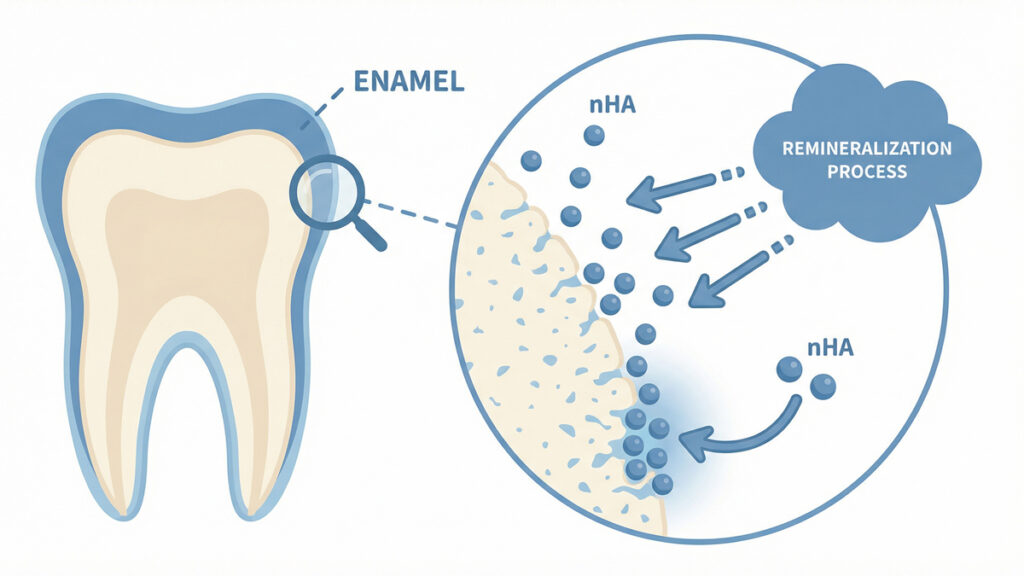
Nano-hydroxyapatite refers to synthetic particles of this mineral produced at an extremely small scale, measured in nanometers, with individual particles sized 20 to 80 nanometers.
At this scale, the particles are small enough to penetrate and fill the microscopic pits, fissures, and early demineralization sites in tooth enamel.
Hydroxyapatite was originally developed by NASA in the 1970s to address bone and tooth mineral density loss in astronauts experiencing zero-gravity conditions.
In the 1980s, the Japanese company Sangi Co.
obtained the NASA patent and began commercializing n-HAp toothpaste.
It has been widely used in Japan and increasingly in Europe for decades, with European regulatory approval preceding its current US popularity by several years.
The mechanism of action differs from that of fluoride.
Fluoride works by chemically converting hydroxyapatite in enamel into fluorapatite, a more acid-resistant mineral that better withstands the acids produced by cavity-causing bacteria.
Nano-hydroxyapatite works mechanically and biomimetically: the particles physically bind to the enamel surface and fill in areas of mineral loss, directly replenishing enamel with the same calcium phosphate mineral it is made of.
Both mechanisms result in stronger, more acid-resistant enamel.
But they accomplish this through different pathways, which is why comparing them requires looking at specific concentrations and specific populations, not simply asking which is “better.”
What Does the Research Actually Show for Children?
This is where precision matters, because marketing claims significantly outpace the actual evidence base.
What the research supports
A study published in BDJ Open (a Nature journal) compared 10% hydroxyapatite toothpaste to 500 ppm fluoride toothpaste for remineralization of early caries lesions.
Both toothpastes produced statistically significant remineralization and reduction in lesion depth, and when compared directly against each other, the difference was not statistically significant.
This is one of the most-cited studies supporting n-HAp equivalency to fluoride.
A broader 2024 systematic review and meta-analysis published in ScienceDirect analyzed 18 clinical studies of hydroxyapatite in oral care products across all ages.
The review concluded that hydroxyapatite-based oral care products can be used by people of all ages, and that, as a sole active ingredient, it is an “ideal substitute for fluoride in toothpaste and mouthwash tailored for young children,” specifically because it is safe if swallowed.
The EU safety conclusion is also meaningful: in 2023, the European Commission’s Scientific Committee on Consumer Safety (SCCS) declared nano-hydroxyapatite safe for use in toothpaste at concentrations up to 10%, specifically reviewing and clearing rod-shaped and spherical particles. That is a rigorous regulatory finding from a respected body.
What the research does not yet support
The BDJ Open study compared n-HAp to 500 ppm fluoride, a low-concentration formulation typically used in toddler toothpastes in some countries.
Standard children’s fluoride toothpaste in the US contains 1,000–1,450 ppm fluoride.
That is two to three times the concentration used in the comparison.
No large-scale long-term randomized controlled trial has compared n-HAp head-to-head against 1,000 ppm fluoride in children over multiple years.
The evidence base for fluoride, spanning decades of real-world population data, thousands of clinical trials, and clear reductions in childhood cavity rates since the 1950s, is vastly larger than the evidence base for n-HAp.
As WebMD summarizes, the FDA has not approved hydroxyapatite toothpaste as an anti-cavity product, and no hydroxyapatite toothpaste currently holds the ADA’s Seal of Acceptance.
This does not mean n-HAp is ineffective.
It means the clinical evidence, while genuinely promising, is not yet at the level required for FDA anti-cavity drug approval or ADA Seal recognition, and parents should understand that distinction when making choices for children at elevated cavity risk.
Is Nano-Hydroxyapatite Safe for Children to Swallow?
This is arguably n-HAp’s most compelling advantage over fluoride for very young children.
When swallowed, nano-hydroxyapatite particles break down in stomach acid into their component minerals: calcium and phosphate.
These are the same minerals found in dairy products, beans, and fish.
There is no equivalent of dental fluorosis, the enamel spotting caused by excess fluoride ingestion during tooth development, associated with swallowing n-HAp.
Toddlers under age 3 cannot reliably spit out toothpaste.
This is why fluoride toothpaste guidelines specify a rice grain-sized smear for this age group to limit total ingestion.
For parents of children who consistently swallow toothpaste despite supervision, n-HAp offers genuine peace of mind that fluoride cannot fully match in that specific context.
One safety caveat: the SCCS safety approval specifically applies to rod-shaped and spherical nanoparticles.
Needle-shaped n-HAp particles raised more concern in earlier safety reviews due to their potential for cellular penetration.
Parents choosing an n-HAp product for young children should look for brands that specify rod-shaped or spherical particle geometry in their formulation.
Which Children Is Nano-Hydroxyapatite Most Appropriate For?
The evidence and expert guidance point to three specific situations where n-HAp may be a reasonable choice and two where it is not.
N-HAp may be appropriate for:
Toddlers under 3 who consistently swallow toothpaste despite parental supervision. The swallowing safety advantage is real, and a well-formulated 10% n-HAp toothpaste used consistently may provide meaningful enamel protection for a low-cavity-risk toddler who has difficulty spitting.
Children with dental fluorosis concerns. Dental fluorosis, with white or brown spots on teeth, occurs when too much fluoride is ingested during enamel development in early childhood. For families who have reason to believe their child has had high fluoride exposure from multiple sources (fluoridated water, supplements, and regular toothpaste), a period of n-HAp use with dentist guidance is a reasonable conversation to have.
Children with a documented low cavity risk and good preventive habits, particularly those drinking fluoridated water (which continues to provide daily systemic fluoride exposure). For a child who brushes consistently, eats a low-sugar diet, has no history of cavities, and drinks NYC tap water, n-HAp toothpaste is unlikely to meaningfully increase cavity risk compared to fluoride toothpaste.
N-HAp is not appropriate as a sole protection for:
Children with a history of multiple cavities or active decay. The long-term cavity prevention data for n-HAp does not match the depth of evidence behind fluoride at standard concentrations. Children who have already demonstrated high cavity susceptibility need the strongest available evidence-based protection.
Children in communities without fluoridated water who are not receiving fluoride from any other source. In this context, fluoride toothpaste is especially important as the primary protective intervention, and substituting n-HAp removes a critical layer of protection without an equivalent replacement.
Our guide to cavities in children covers how to assess your child’s cavity risk level, which is the most important factor in deciding whether n-HAp is appropriate for your family.
How Do the Main Brands Compare?
Not all n-HAp toothpastes for children are equivalent.
Key differences include n-HAp concentration, particle shape, additional active ingredients, and whether they contain fluoride alongside n-HAp.
| Brand | n-HAp Concentration | Contains Fluoride? | ADA Seal? | Notes |
|---|---|---|---|---|
| Kinder Karex | 10% | No | No | Developed specifically for children; widely used in Europe; most studied pediatric n-HAp brand |
| Boka Kids | Proprietary (n-HAp-based) | No | No | US brand; popular in natural parenting communities; higher price point (~$15–$20/tube) |
| David’s Hydroxi Kids | Not specified publicly | No | No | New kid-specific line launched early 2026; natural ingredients focus; EWG Verified |
| RiseWell Kids | Not specified publicly | No | No | US brand; marketed as mineral-rich and fluoride-free; available online |
For comparison, standard children’s fluoride toothpastes (Crest Kids, Colgate Kids) carry the ADA Seal of Acceptance, have decades of clinical validation, and cost $3–$6 per tube.
When evaluating n-HAp products, parents should verify the n-HAp concentration (look for 10% for clinical relevance), confirm rod-shaped particles where listed, and avoid products that make specific anti-cavity disease claims not supported by FDA approval.
What Do Pediatric Dentists Recommend?
The official position of the American Dental Association is that fluoride toothpaste remains the gold standard for cavity prevention, and the ADA Seal is currently awarded only to fluoride products.
The American Academy of Pediatric Dentistry similarly recommends fluoride toothpaste starting at the first tooth.
In clinical practice, however, the picture is more nuanced. Many pediatric dentists have begun recommending a middle-ground approach: using n-HAp in the morning for its remineralization and safety-if-swallowed benefits, while using a fluoride toothpaste or receiving fluoride varnish at dental visits for stronger long-term cavity protection.
This “hybrid” approach is increasingly discussed in dental practice communities in 2026, particularly for low-risk children in fluoridated water communities.
The key point: the decision to use n-HAp toothpaste, especially as a replacement for fluoride, should be made with your pediatric dentist based on your child’s specific cavity risk level, diet, water supply, and dental history.
Understanding what toothpaste ingredients to look for and avoid is a helpful starting point for that conversation.
And for a full review of your child’s oral health routine by age, see our kids oral hygiene guide.
The Bottom Line on Nano-Hydroxyapatite Toothpaste for Kids
Nano-hydroxyapatite toothpaste is a legitimate oral care ingredient backed by real science, genuine regulatory approval in Europe, and growing clinical evidence, but it is not a proven equivalent to fluoride toothpaste for children at elevated cavity risk.
The FDA has not approved it as an anti-cavity product. No brand holds the ADA Seal.
The most rigorous comparison studies used low-concentration fluoride (500 ppm), not the 1,000–1,450 ppm standard in US children’s toothpaste.
For parents of toddlers who swallow toothpaste, or for low-risk children in fluoridated water communities who want to reduce fluoride exposure from toothpaste, n-HAp is a reasonable option to discuss with your dentist.
For children with a history of cavities, high sugar intake, or limited access to fluoridated water, fluoride toothpaste remains the evidence-based first choice.
The best dental product for your child is always the one they will use consistently in the right amount, twice a day, starting at the first tooth.
This article provides general information about children’s toothpaste ingredients and does not replace professional dental or medical advice. Always consult your child’s pediatric dentist before switching toothpaste, especially for children with active decay or high cavity risk.
Frequently Asked Questions About Hydroxyapatite Toothpaste for Kids
Is hydroxyapatite toothpaste approved by the FDA for kids?
No. The FDA has not approved nano-hydroxyapatite as an anti-cavity drug product. In the US, the FDA currently approves only fluoride as an anti-cavity active ingredient in toothpaste.
No n-HAp toothpaste holds the ADA Seal of Acceptance.
This does not mean it is ineffective, but it means it has not passed the regulatory bar required for an official anti-cavity claim on packaging.
Does hydroxyapatite toothpaste prevent cavities as well as fluoride?
Studies suggest n-HAp at 10% concentration is comparable to low-concentration fluoride (500 ppm) for early enamel remineralization.
However, most US children’s fluoride toothpastes use 1,000–1,450 ppm two to three times higher.
Long-term head-to-head trials comparing n-HAp to standard-concentration fluoride in children do not yet exist at the scale needed for definitive conclusions.
Is it safe if my toddler swallows hydroxyapatite toothpaste?
Yes. When swallowed, n-HAp particles break down into calcium and phosphate in stomach acid, the same minerals found in milk and cheese.
There is no equivalent of dental fluorosis risk.
This swallowing safety is n-HAp’s most compelling advantage over fluoride for very young children who cannot reliably spit.
Look for brands that specify rod-shaped particles rather than needle-shaped, as rod-shaped particles have cleared more rigorous safety evaluations.
What is the difference between hydroxyapatite and nano-hydroxyapatite?
Standard hydroxyapatite particles are generally larger than 100 nanometers.
At that size, they can sit on the tooth surface but cannot penetrate into microscopic enamel defects effectively.
Nano-hydroxyapatite particles are sized 20 to 80 nanometers, small enough to enter and fill the microscopic pits and lesions in weakened enamel.
Most children’s products marketed today use the nano form for this reason.
Should I switch my child from fluoride to hydroxyapatite toothpaste?
Only with guidance from your pediatric dentist, based on your child’s specific cavity risk.
For low-risk children in fluoridated water communities, switching or using a hybrid approach may be reasonable.
For children with a history of multiple cavities, high sugar intake, or no access to fluoridated water, fluoride toothpaste remains the stronger evidence-based choice, and switching increases cavity risk.
Which hydroxyapatite toothpaste brands are best for children?
Kinder Karex is the most clinically studied pediatric n-HAp brand and is widely used in Europe.
Boka Kids and Davids Hydroxi Kids are popular US options. All lack the ADA Seal.
Look for products that specify 10% n-HAp concentration and rod-shaped particles.
Avoid products making specific disease prevention claims not supported by FDA approval, and choose a flavor your child will actually use; consistency matters more than brand.

Mary – Queens Pediatric Dental Resource Manager. I’m a dental health researcher and parent advocate based in Queens, NY. After struggling to find reliable pediatric dental information during my own child’s dental emergency, I created this resource to help other Queens families navigate their children’s oral health needs.
I curate evidence-based information from leading pediatric dental organizations, peer-reviewed research, and trusted dental health experts. While I’m not a dentist, I’m committed to providing accurate, practical guidance that helps parents make informed decisions.
All content is thoroughly researched and includes proper medical disclaimers directing families to consult qualified pediatric dentists for their children’s specific needs.