
Quick Answer
Children should have their first dental visit by age 1 or within 6 months of their first tooth appearing—whichever comes first. The American Academy of Pediatric Dentistry (AAPD) recommends this timeline to establish a “dental home,” catch problems early, and help children develop positive associations with dental care before any treatment becomes necessary.
Key Takeaways
- ✓ Schedule baby’s first dental visit by their first birthday (the “Age 1 Dental Visit”)
- ✓ The first visit is gentle—usually just a quick exam with your child on your lap
- ✓ Pediatric dentists have 2-3 years of specialized training beyond dental school
- ✓ Early visits prevent 40% of emergency dental care needs before age 5
- ✓ Most visits are covered by dental insurance and Medicaid programs
- ✓ Preparation at home dramatically reduces dental anxiety
When Should My Child First See a Dentist?
Your child should see a pediatric dentist by their first birthday or within 6 months after their first tooth erupts—whichever milestone comes first.
This recommendation comes directly from the American Academy of Pediatric Dentistry (AAPD), American Dental Association (ADA), and American Academy of Pediatrics (AAP).
While this timeline surprises many parents—after all, most babies only have a few teeth by age 1—there’s strong clinical evidence supporting early visits.
According to CDC data, 23% of children aged 2-5 already have untreated cavities. Starting dental care early helps identify risk factors before decay develops.
Why Age 1? The Science Behind Early Dental Visits
Research published in the journal Pediatrics found that children who have their first dental visit before age 1 are 40% less likely to require emergency dental treatment by age 5.
The early visit allows dentists to:
- Assess cavity risk: Some children are more prone to decay due to diet, bacteria levels, or enamel quality
- Apply preventive treatments: Fluoride varnish can strengthen developing enamel
- Guide feeding practices: Bottle and breastfeeding habits significantly impact dental health
- Establish a dental home: Having a relationship with a dentist before emergencies occur
- Build positive associations: Children who start early rarely develop dental phobia
Clinical Insight
“In my 15 years treating children in Queens, I’ve observed that kids who start dental visits before age 1 rarely develop dental anxiety. The key is making that first visit about exploration, not treatment. We call these ‘knee-to-knee’ exams where parents hold their child on their lap—it builds trust before any clinical work begins.”
— Dr. Mary G. Trice, DDS
What If My Child Is Older and Has Never Been to the Dentist?
It’s never too late to start. If your child is 2, 3, or even older without having seen a dentist, schedule an appointment now.
Pediatric dentists are specially trained to work with children at any stage—including those who may need to “catch up” on care.
For children who’ve had limited dental exposure, the first visit may include additional time for gradual introduction to the dental environment.
Some practices offer “happy visits” or “practice visits” specifically designed for anxious children, where no actual treatment occurs—just exploration and trust-building.
What Happens at a Baby’s First Dental Visit?
The first dental visit is typically brief (15-30 minutes) and focuses on examination and education rather than treatment.
Most parents are pleasantly surprised by how gentle and quick the appointment is.
The Knee-to-Knee Examination
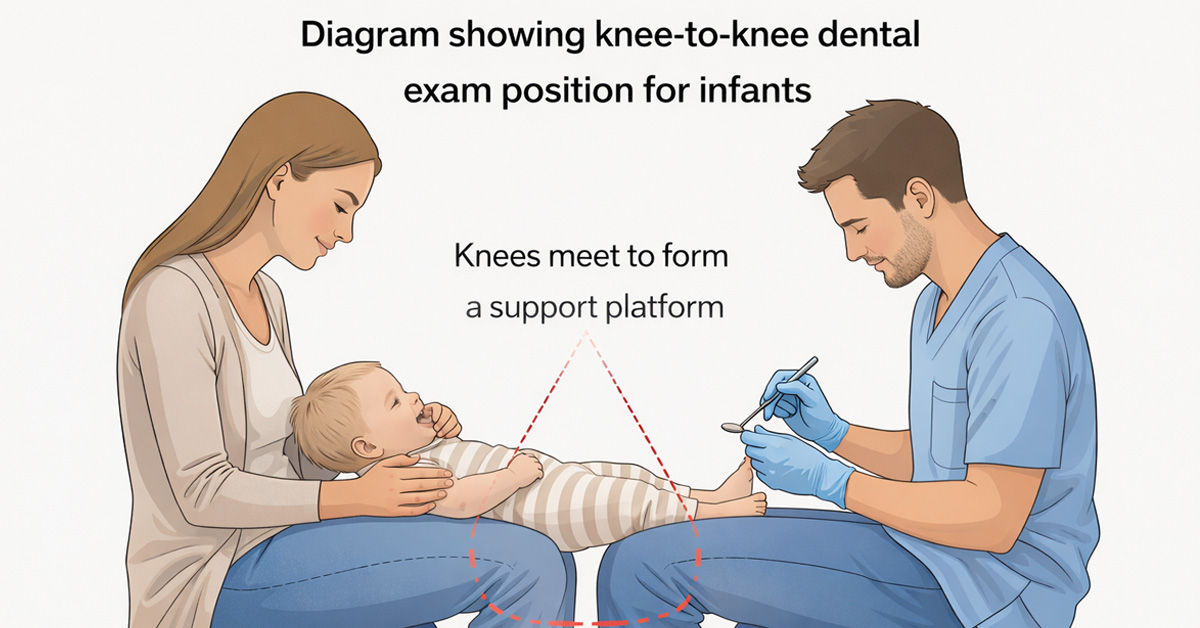
For infants and young toddlers, pediatric dentists commonly use the “knee-to-knee” or “lap-to-lap” examination technique.
Here’s how it works:
- You sit facing the dentist, with both of you in chairs at the same height
- Your child sits on your lap facing you, feeling secure in a familiar position
- The child gently reclines back onto the dentist’s lap for the examination
- You maintain eye contact and can hold your child’s hands for reassurance
- The dentist examines while your child sees your face throughout
This position keeps babies calm because they never lose sight of their parent—it’s the most parent-centered approach in pediatric dentistry.
What the Dentist Will Check
During the examination, the pediatric dentist assesses several aspects of your child’s oral health:
| Area Examined | What the Dentist Looks For |
|---|---|
| Teeth | Early cavities, white spots (demineralization), proper spacing, enamel quality |
| Gums | Signs of gum disease, eruption cysts, swelling, unusual color |
| Jaw & Bite | Jaw development, bite alignment, crossbite or underbite indicators |
| Tongue & Palate | Tongue tie (ankyloglossia), lip tie, palate formation |
| Soft Tissues | Cheeks, lips, and oral tissues for any abnormalities |
| Habits | Effects of thumb sucking, pacifier use, or bottle feeding |
First Visit Procedures
Depending on your child’s age and individual needs, the first visit may include:
- Gentle cleaning: Removing any plaque with a soft brush or cloth
- Fluoride varnish: A protective coating painted on teeth (takes 30 seconds, tastes like candy)
- Tooth counting: Documentation of which teeth have emerged
- X-rays: Usually NOT taken at the first visit for infants; typically start around age 2-3
What You’ll Learn as a Parent
A significant portion of the first visit is dedicated to parent education.
Your pediatric dentist will discuss:
- Proper brushing techniques for your child’s age
- When to start and how to floss baby teeth
- Appropriate fluoride levels (toothpaste amounts, supplements if needed)
- Diet recommendations for dental health
- Teething timeline and what to expect
- When and how to wean from bottle or pacifier
- Injury prevention and what to do in dental emergencies
How to Prepare Your Child for Their First Dental Visit
Preparation is the single most important factor in ensuring a positive first dental experience.
Children who are mentally prepared for what will happen show significantly less anxiety and better cooperation during appointments.
Age-Appropriate Preparation Strategies
For Infants (Under 12 Months)
Babies don’t require mental preparation, but parents can help by:
- Scheduling during your baby’s happiest time of day (usually morning after a nap)
- Bringing a familiar comfort item (blanket, stuffed toy)
- Feeding 1-2 hours before (not right before—full babies may spit up when reclined)
- Staying calm yourself—babies sense parental anxiety
For Toddlers (Ages 1-3)
- Read dental-themed books together: “The Berenstain Bears Visit the Dentist” and “Peppa Pig: Dentist Trip” are excellent choices
- Play pretend dentist: Use a toothbrush to “count” your child’s teeth, then let them count yours
- Use positive language: Say “The dentist will count your teeth and make them sparkle!” instead of “It won’t hurt”
- Avoid negative words: Never mention pain, shots, or drills—toddlers pick up on these words even if you’re saying “no pain”
- Visit the office beforehand: Many pediatric dental offices allow families to stop by and see the waiting room before the actual appointment
For Preschoolers (Ages 3-5)
- Watch kid-friendly videos about dental visits (avoid any showing children crying)
- Role-play with a stuffed animal as the “patient”
- Let them choose their own toothbrush color to bring
- Discuss the visit 2-3 days ahead (not weeks in advance, which can build anxiety)
- Promise a small reward for cooperation (not candy—perhaps stickers or a trip to the park)
Clinical Insight
“One preparation mistake I see repeatedly is parents projecting their own dental fears. If you’re anxious about dentists yourself, try not to share those stories with your child. Children who come in with neutral expectations almost always have better experiences than those whose parents have warned them about what might happen—even with good intentions.”
— Dr. Mary G. Trice, DDS
What to Bring to the First Appointment
- Insurance card or Medicaid information
- Completed new patient forms (often available online to fill out beforehand)
- List of medications your child takes
- Medical history notes (especially any allergies, heart conditions, or bleeding disorders)
- Comfort item (favorite blanket, stuffed animal)
- Questions you want to ask the dentist
Pediatric Dentist vs. Family Dentist: Which Should You Choose?
For children under 12—especially for first dental visits—a pediatric dentist offers significant advantages.
Pediatric dentists complete 2-3 years of specialized residency training beyond dental school, focusing exclusively on children’s unique developmental, psychological, and dental needs.
| Factor | Pediatric Dentist | Family Dentist |
|---|---|---|
| Training | 2-3 years additional specialty training in child development, behavior management, and pediatric conditions | General dental training covering all ages; pediatric exposure varies |
| Office Environment | Child-friendly design with play areas, TVs on ceilings, themed rooms, smaller equipment | General waiting room serving all ages; may not have child-specific features |
| Behavior Management | Specialized techniques: tell-show-do, positive reinforcement, distraction, nitrous oxide | Basic behavior guidance; may refer out for anxious children |
| Sedation Options | Full range: nitrous oxide, oral sedation, IV sedation, general anesthesia | May offer nitrous oxide; often refers out for other sedation types |
| Special Needs | Extensive training in treating children with autism, ADHD, Down syndrome, cerebral palsy, sensory disorders | Experience varies significantly; may refer to specialists |
| Age Range | Birth through adolescence (typically up to age 18-21) | All ages; convenient for whole family in one location |
When a Pediatric Dentist Is Strongly Recommended
While any dentist can technically see children, certain situations make a pediatric specialist the clear choice:
- First dental visits (establishing positive associations is crucial)
- Children under age 3 (requires infant-specific techniques)
- Any child with dental anxiety (specialized behavior management)
- Children with special healthcare needs (autism, ADHD, sensory processing disorders)
- Complex dental issues (multiple cavities, extractions, crowns)
- Medical conditions affecting dental care (heart defects, bleeding disorders, immunocompromised)
How Often Should Children Visit the Dentist?
Most children should see a dentist every 6 months for routine checkups and cleanings.
However, your pediatric dentist may recommend a different schedule based on your child’s individual risk factors.
| Visit Frequency | Recommended For | Why |
|---|---|---|
| Every 3-4 months | High cavity risk, history of decay, orthodontic treatment | More frequent fluoride, closer monitoring |
| Every 6 months | Most children with average risk | Standard preventive care interval |
| Every 12 months | Very low risk, excellent home care, no history of cavities | May be appropriate after discussion with dentist |
Risk Factors That May Require More Frequent Visits
- Previous cavities (one cavity increases risk for more)
- Diet high in sugar, juice, or frequent snacking
- White spots on teeth (early demineralization)
- Inadequate fluoride exposure
- Special needs affecting oral hygiene
- Orthodontic appliances (braces, expanders)
- Family history of severe dental problems
How Much Does a Child’s First Dental Visit Cost?
A child’s first dental visit typically costs between $50-$200 without insurance, depending on location and services provided.
The good news: most dental insurance plans and all Medicaid programs cover preventive pediatric dental care.
| Service | Typical Cost (Without Insurance) |
|---|---|
| Initial exam (comprehensive) | $50-$150 |
| Infant cleaning | $30-$75 |
| Fluoride varnish application | $20-$50 |
| X-rays (if needed, usually not at first infant visit) | $25-$100 |
| Total First Visit Range | $50-$200 |
Insurance Coverage for Children’s Dental Care
Most insurance plans cover preventive pediatric dental care at 100%.
Under the Affordable Care Act, dental coverage for children is considered an “essential health benefit,” and many marketplace plans include pediatric dental.
What’s Typically Covered
- Preventive visits: Usually 2 per year at 100% coverage
- Fluoride treatments: Typically covered through age 18
- Sealants: Often covered for permanent molars
- X-rays: Usually once per year
Medicaid and CHIP Coverage
All state Medicaid programs are required to cover comprehensive dental services for children under the Early and Periodic Screening, Diagnostic, and Treatment (EPSDT) benefit.
This includes:
- Exams and cleanings
- Fluoride treatments
- Fillings and extractions
- Emergency care
- Space maintainers
In New York State, Child Health Plus and Medicaid provide comprehensive pediatric dental coverage. Find Medicaid-accepting pediatric dentists in Queens →
Questions to Ask at Your Child’s First Dental Visit
Prepare these questions to make the most of your appointment:
About Your Child’s Oral Health
- Are my child’s teeth developing normally?
- Is my child at high, medium, or low risk for cavities?
- Do you see any early signs of decay?
- Is my child’s bite developing properly?
- When should we expect the next teeth to come in?
About Home Care
- Am I brushing my child’s teeth correctly?
- How much fluoride toothpaste should I use?
- When should we start flossing?
- Should my child use fluoride supplements?
- What foods should we avoid or limit?
About Habits
- When should my child stop using a pacifier?
- Is thumb sucking affecting their teeth?
- Should we be concerned about teeth grinding?
- When should we transition from bottle to cup?
What If My Child Has Dental Anxiety?
Some level of apprehension about the dentist is completely normal—and manageable.
Pediatric dentists are specifically trained in techniques to help anxious children feel comfortable.
Behavior Management Techniques Used by Pediatric Dentists
- Tell-Show-Do: Explaining each step, demonstrating on a model or finger, then performing on the child
- Positive reinforcement: Praising cooperation, offering small rewards like stickers
- Distraction: TVs on the ceiling, headphones with music, toys to hold
- Voice control: Using a calm, steady tone to help children feel safe
- Modeling: Having older siblings or parents demonstrate that procedures don’t hurt
When Sedation Might Be Recommended
For some children, behavior management techniques alone aren’t enough.
Your dentist may recommend sedation if your child:
- Has severe anxiety that prevents examination
- Requires extensive dental work
- Has special needs that make cooperation difficult
- Is very young and needs multiple procedures
Sedation options range from nitrous oxide (“laughing gas,” the mildest option) to oral sedation to general anesthesia for complex cases. Learn more about pediatric dental sedation options →
Finding a Pediatric Dentist in Queens, NY
Queens offers numerous excellent pediatric dental practices. Here’s how to find the right fit for your family:
What to Look for in a Pediatric Dentist
- Board certification: Look for diplomates of the American Board of Pediatric Dentistry
- Child-friendly office: Play areas, themed rooms, staff experienced with children
- Convenient location: Close to home or school for easy scheduling
- Insurance acceptance: Verify your plan is accepted before scheduling
- Languages spoken: Important in Queens’ diverse communities
- Emergency availability: What happens if there’s a dental emergency after hours?
- Parent reviews: Check Google, Yelp, and Healthgrades for patient experiences
Queens Neighborhood Dental Resources
Find pediatric dentists by neighborhood:
- Pediatric Dentists in Astoria
- Pediatric Dentists in Flushing
- Pediatric Dentists in Jackson Heights
- Pediatric Dentists in Jamaica
- Pediatric Dentists in Forest Hills
- Pediatric Dentists in Bayside
- Medicaid-Accepting Dentists in Queens
Frequently Asked Questions About First Dental Visits
Is the first dental visit really necessary for a 1-year-old?
Yes. The American Academy of Pediatric Dentistry, American Dental Association, and American Academy of Pediatrics all recommend the first dental visit by age 1.
Research shows that children who see a dentist early are 40% less likely to need emergency dental treatment by age 5.
The visit establishes a “dental home” and allows early detection of risk factors for decay.
Will my baby need X-rays at the first visit?
Usually not. X-rays are typically not taken at the first visit for infants.
Most pediatric dentists wait until around age 2-3, when more teeth have erupted and the child can cooperate with the X-ray process. X-rays become important once teeth are touching (to check for cavities between teeth) or if there’s a specific concern.
What if my child cries during the examination?
Crying is completely normal and expected—pediatric dentists are prepared for it.
The examination is very quick (often under a minute), and crying actually helps the dentist see the teeth better.
Parents are usually surprised how quickly their child calms down, especially when they see the exam wasn’t painful.
Consistent early visits help reduce anxiety over time.
Should I stay in the room during my child’s appointment?
For the first visit and young children, absolutely yes. Parents should stay for the knee-to-knee exam and are typically in the room throughout.
As children grow older (usually around age 3-4), some pediatric dentists may ask parents to wait in the reception area—children often behave better without parental presence.
Discuss your preference with the dentist beforehand.
Do I need to clean my baby’s gums before teeth come in?
Yes, you should clean your baby’s gums even before teeth appear.
Use a soft, damp cloth to gently wipe the gums after feedings.
This removes bacteria, helps your baby get used to oral care, and establishes the habit early.
Once the first tooth erupts, switch to a soft infant toothbrush with a rice-grain-sized smear of fluoride toothpaste.
How long does the first dental visit take?
Plan for 30-45 minutes total, though the actual examination takes only a few minutes.
The extra time allows for paperwork, meeting the staff, parent education about home care, and answering your questions.
Some offices schedule longer “get acquainted” appointments specifically for first visits to ensure no one feels rushed.
What’s the best time of day to schedule the appointment?
Schedule during your child’s happiest, most alert time—usually morning after a nap and meal.
Avoid scheduling when your child is typically tired, hungry, or fussy.
The goal is to catch them at their best. Let the dental office know your child’s typical nap schedule when booking.
Can both parents come to the first visit?
Yes, and it’s encouraged if possible. Having both parents learn about proper oral hygiene techniques ensures consistency in home care.
Many offices welcome both parents. Just let them know when scheduling so they can accommodate seating in the treatment area.
Related Guides
Continue learning about your child’s dental health:
- How to Brush a Baby’s Teeth: Complete Guide by Age
- Baby Teething Timeline: When Each Tooth Appears
- Preventing Cavities in Children: Evidence-Based Strategies
- What to Do If Your Child Is Scared of the Dentist
- Fluoride for Kids: Everything Parents Need to Know
- Dental Sealants: Protection for Your Child’s Teeth
Sources & References
- American Academy of Pediatric Dentistry. (2024). Periodicity of Examination, Preventive Dental Services, Anticipatory Guidance/Counseling, and Oral Treatment for Infants, Children, and Adolescents. AAPD Reference Manual.
- Centers for Disease Control and Prevention. (2024). Oral Health Surveillance Report: Trends in Dental Caries and Sealants, Tooth Retention, and Edentulism, United States. CDC.
- American Dental Association. (2024). Baby Teeth. MouthHealthy.org.
- Beil, H., et al. (2014). Early dental visits and oral health outcomes. Pediatrics, 133(5), e1202-e1208.
- American Academy of Pediatrics Section on Oral Health. (2014). Maintaining and improving the oral health of young children. Pediatrics, 134(6), 1224-1229.
Medical Disclaimer
This article is for informational purposes only and does not constitute medical advice. Always consult with a qualified pediatric dentist for guidance specific to your child’s needs. Information is current as of January 2026 but dental guidelines may be updated periodically.

Mary – Queens Pediatric Dental Resource Manager. I’m a dental health researcher and parent advocate based in Queens, NY. After struggling to find reliable pediatric dental information during my own child’s dental emergency, I created this resource to help other Queens families navigate their children’s oral health needs.
I curate evidence-based information from leading pediatric dental organizations, peer-reviewed research, and trusted dental health experts. While I’m not a dentist, I’m committed to providing accurate, practical guidance that helps parents make informed decisions.
All content is thoroughly researched and includes proper medical disclaimers directing families to consult qualified pediatric dentists for their children’s specific needs.