Emergency room visits for non-traumatic dental pain in children under age 15 rose nearly 60 percent between 2019 and 2022, according to data from the CareQuest Institute for Oral Health published in a major KFF Health News investigation on March 10, 2026.
At Children’s Hospital Colorado, non-traumatic dental ER cases climbed 175 percent between 2010 and 2025.
The surge is not caused by more tooth injuries; it is caused by children not seeing a dentist until their tooth pain becomes an emergency.
Families across the country, and right here in Queens, are losing access to preventive pediatric dental care at a moment when federal funding and fluoride protections are also under threat.
WHAT YOU NEED TO KNOW
- The crisis: ER visits for children’s tooth pain rose nearly 60% from 2019 to 2022, driven by a shortage of dentists who accept Medicaid.
- Who is most affected: Children on Medicaid and children with special healthcare needs more than 1 in 4 of all children.
- The Queens angle: NYC has one of the nation’s largest Medicaid-enrolled child populations. Proposed federal Medicaid cuts could worsen access beginning late 2026.
- What to do now: If your child has not seen a dentist in the past 6 months, schedule an appointment today do not wait for pain to develop.
- Who confirmed this: CareQuest Institute for Oral Health, KFF Health News, CBS News (March 10, 2026).
The Full Picture: What the Data Shows
The 60 percent rise in children’s dental ER visits is not a new trend it reflects a decade-long deterioration in pediatric dental access that accelerated during and after the COVID-19 pandemic.
The CareQuest Institute data, cited in the KFF Health News investigation, captures only non-traumatic dental cases: children arriving in emergency rooms because a tooth became so infected or painful that parents had nowhere else to turn.
The root cause is a structural access problem.
Only 1 in 3 dentists in the United States accepts Medicaid, according to the KFF Health News investigation.
Medicaid reimbursement rates for dental services are so low in most states that dentists cannot cover their costs.
In states where rates are higher, access improves.
Where rates are low, as they are in many parts of New York, families face a practical shortage of providers even when they technically have insurance coverage.
For a comprehensive breakdown of whether Medicaid covers your child’s dental care, including what procedures are included and how to find a participating provider in Queens, we have a full guide on this site.
The crisis is compounded by a workforce shortage.
The KFF investigation notes that nearly half of dentists practicing in New York City are approaching retirement age, and not enough dental school graduates are choosing pediatric specialties or accepting Medicaid to replace them.
Why This Matters for Parents
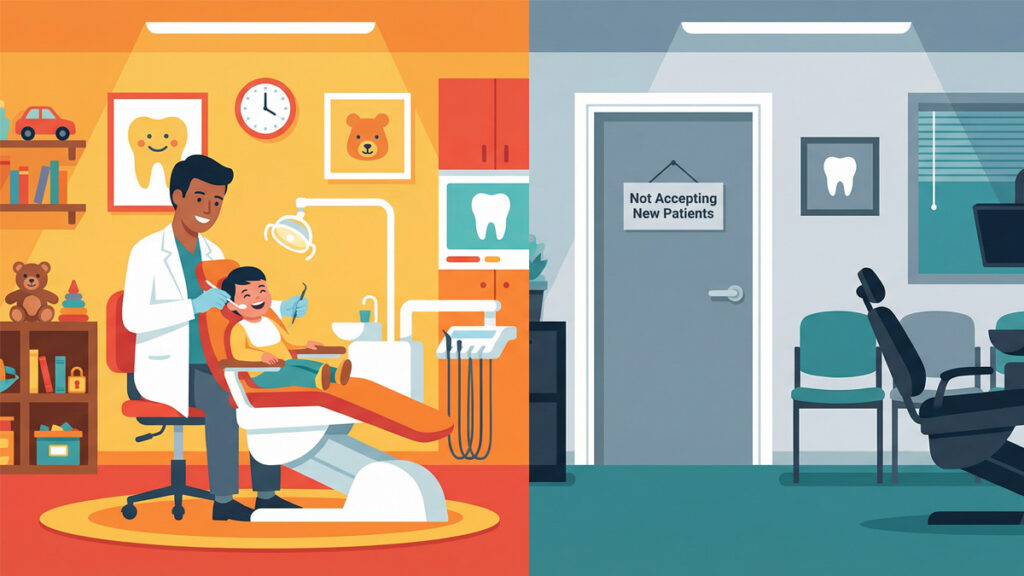
When a child goes to an emergency room for tooth pain, the ER can treat the infection or pain, but cannot fix the underlying tooth.
The child still needs to see a dentist often within days for the actual dental procedure.
Most emergency rooms do not have dentists on staff.
What they offer is pain medication, antibiotics, and a referral.
That means an ER visit for tooth pain is both expensive and incomplete: it solves nothing in the long term.
The real cost is borne by children.
Untreated cavities in children do not stay small.
A cavity that could have been treated with a simple filling at a routine checkup can progress to an abscess, requiring extraction or a pulpotomy.
Research consistently shows that tooth infections in children can spread to surrounding tissue and, in rare but documented cases, become life-threatening.
The KFF investigation highlights children with special healthcare needs as particularly vulnerable: more than 26 percent of all children have a special healthcare need, and these children are twice as likely to have unmet dental needs compared to children without disabilities.
The broader policy picture is alarming.
The proposed federal “One Big Beautiful Bill Act” would cut Medicaid spending by more than $900 billion over a decade.
Work requirements for adult Medicaid enrollees begin in December 2026.
Eligibility re-verification every 6 months begins in January 2027.
Research cited in the KFF article shows that when parents lose Medicaid coverage, children who retain coverage become less likely to visit the dentist because the parent can no longer take time off work or afford transportation without their own coverage in place.
The children’s access deteriorates as a side effect of adult policy changes.
What Pediatric Dental Organizations Are Saying
The American Academy of Pediatric Dentistry (AAPD), representing more than 11,000 pediatric dentists nationwide, has consistently documented the relationship between Medicaid reimbursement rates and pediatric dental access.
In its official policy position on Medicaid reimbursement, the AAPD states that low reimbursement rates are the single largest barrier to pediatric dental access for low-income children, and has called on federal and state governments to increase rates to at least 75 percent of standard dental fees.
The CDC’s Division of Oral Health, which for decades tracked children’s dental health data, funded school sealant programs, and supported community fluoridation, was eliminated on April 1, 2025, as part of HHS restructuring.
Its loss removes the primary federal mechanism for monitoring and improving children’s oral health outcomes at the population level.
The AAPD and ADA have both called for the division’s restoration.
At least 15 states introduced legislation in 2026 to ban or limit community water fluoridation, a measure supported by decades of evidence showing fluoride reduces childhood cavities by up to 25 percent.
Any rollback of fluoridation would disproportionately affect children in lower-income communities who rely on tap water rather than bottled water.
What This Means for Your Child By Age Group
The guidance changes depending on your child’s age, but the core message is the same: do not wait for pain.
Dental pain in children is a sign that the disease has already progressed significantly.
Babies and toddlers (ages 0–3): The American Academy of Pediatric Dentistry recommends a child’s first dental visit by their first birthday or within 6 months of the first tooth appearing, whichever comes first.
Many parents skip this visit, assuming baby teeth do not matter.
They do cavities in baby teeth, cause pain, affect eating and speech, and increase the risk of decay in permanent teeth.
If your baby has not yet had their first dental visit, schedule one now.
Preschoolers (ages 3–5): This is the age group most affected by the ER surge. Preschoolers should see a dentist every 6 months for cleanings and fluoride varnish application.
If your child’s dentist does not accept your insurance and you are struggling to find one who does, contact NYC’s 311 system and ask for a referral to a federally qualified health center (FQHC) in Queens.
These centers provide dental services on a sliding-scale fee basis, regardless of insurance status.
School-age children (ages 6–12): Children in this age group are losing baby teeth and growing permanent teeth simultaneously, a period when cavities in baby teeth can directly damage the permanent teeth developing beneath them.
Regular 6-month checkups are essential.
If cost is a barrier, ask your child’s school nurse about school-based dental screening programs in your district.
New York State just announced $10 million in funding for school-based children’s dental care at 33 schools statewide programs at your child’s school may expand in 2026.
If your child is in pain right now, do not wait for a routine appointment.
Call a pediatric dental office and describe the symptoms.
Most pediatric dental practices will see emergency cases within 24 hours.
You can also find Queens pediatric dentists currently accepting patients through our directory.
Frequently Asked Questions About Children’s Dental ER Visits
Why are more children going to the ER for tooth pain?
The primary reason is a shortage of pediatric dentists who accept Medicaid.
Only 1 in 3 US dentists accepts Medicaid, leaving millions of low-income children without a regular dental provider.
When a cavity or infection goes untreated because a family cannot find or afford a dentist, the pain eventually becomes severe enough to require emergency care.
The problem has worsened since the COVID-19 pandemic disrupted routine dental care.
Can an emergency room fix my child’s tooth problem?
No. Hospital emergency rooms can prescribe antibiotics to treat a dental infection and provide pain medication, but they cannot perform dental procedures.
A child seen in the ER for a dental problem still needs to see a dentist often, within 24 to 48 hours, for the actual treatment.
The ER visit manages the immediate crisis; it does not resolve the underlying dental condition.
Does Medicaid cover dental care for children in New York?
Yes. Medicaid in New York covers preventive dental care for children, including exams, cleanings, X-rays, sealants, fillings, and extractions.
The challenge is finding a dentist who accepts Medicaid as payment.
Federally qualified health centers (FQHCs) in Queens accept Medicaid and serve patients regardless of insurance status on a sliding-fee scale.
Call 311 for a referral to the nearest FQHC dental clinic.
What should I do if my child has a toothache right now?
Call a pediatric dental office first, describe the symptoms, and ask for an emergency same-day or next-day appointment.
Most pediatric practices accommodate dental emergencies quickly.
If your child has facial swelling, fever above 101°F, tooth pain, or difficulty swallowing or breathing, go to an emergency room immediately.
These are signs that the infection may be spreading beyond the tooth and require urgent medical attention.
Medical disclaimer: This article is for informational purposes only and does not constitute medical or dental advice. Always consult a licensed pediatric dentist for diagnosis and treatment of your child's dental health concerns.
Reviewed by the Pediatric Dentist in Queens Editorial Team. Last Updated: March 14, 2026.
SOURCE LIST
1. KFF Health News / CBS News — “More Kids Are in ERs for Tooth Pain. Trump Cuts and RFK Jr.’s Anti-Fluoride Fight Aren’t Helping.” March 10, 2026. https://kffhealthnews.org/news/article/dental-care-emergency-rooms-special-needs-medicaid-shortage-areas Also at: https://www.cbsnews.com/news/children-emergency-room-tooth-pain-dental-care/
2. Dimensions of Dental Hygiene — “The CDC’s Division of Oral Health Receives Devastating Blow.” (documenting CDC Division of Oral Health elimination, April 1, 2025) https://dimensionsofdentalhygiene.com/the-cdcs-division-of-oral-health-receives-devastating-blow/
3. AAPD — Reference Manual of Pediatric Dentistry (policy positions on Medicaid reimbursement and access) https://www.aapd.org/research/oral-health-policies–recommendations/overview/
4. KFF Health News — “Medicaid Is Paying for More Dental Care. GOP Cuts Threaten To Reverse the Trend.” https://kffhealthnews.org/news/article/medicaid-cuts-dental-coverage-republicans-big-beautiful-bill/

Mary – Queens Pediatric Dental Resource Manager. I’m a dental health researcher and parent advocate based in Queens, NY. After struggling to find reliable pediatric dental information during my own child’s dental emergency, I created this resource to help other Queens families navigate their children’s oral health needs.
I curate evidence-based information from leading pediatric dental organizations, peer-reviewed research, and trusted dental health experts. While I’m not a dentist, I’m committed to providing accurate, practical guidance that helps parents make informed decisions.
All content is thoroughly researched and includes proper medical disclaimers directing families to consult qualified pediatric dentists for their children’s specific needs.