
Quick Answer
Cavities (tooth decay) are caused when bacteria in the mouth produce acids that dissolve tooth enamel. They’re the most common chronic childhood disease—affecting 23% of children ages 2-5—but they’re almost entirely preventable with proper brushing, fluoride, limited sugar, and regular dental visits. Yes, cavities in baby teeth usually need treatment to prevent pain, infection, and damage to permanent teeth developing below.
Key Takeaways
- ✓ Cavities form when bacteria + sugar = acid that attacks tooth enamel
- ✓ Getting one cavity significantly increases risk for more cavities
- ✓ Yes, cavities in baby teeth need treatment—they can cause pain and affect permanent teeth
- ✓ Very early cavities can sometimes be reversed with fluoride
- ✓ Prevention is far easier than treatment: brush 2x daily, limit sugar, use fluoride
- ✓ Dental sealants reduce cavity risk by 80% in back teeth
What Causes Cavities in Children?
Cavities form through a specific process involving bacteria, sugar, and acid.
Understanding this process helps you prevent cavities effectively.
The Cavity Process: Step by Step
- Bacteria colonize the mouth: Within hours of birth, bacteria begin living in your baby’s mouth. The main cavity-causing bacteria is Streptococcus mutans
- Sugar feeds the bacteria: When your child eats or drinks sugar (including natural sugars), bacteria feed on it
- Bacteria produce acid: As bacteria digest sugar, they produce acid as a byproduct
- Acid attacks enamel: This acid dissolves minerals from tooth enamel (demineralization)
- Cavity forms: If demineralization outpaces remineralization (repair), a cavity develops
This process takes time—cavities don’t form overnight.
That’s why consistent daily prevention works so well.
Risk Factors That Increase Cavity Risk
| Risk Factor | Why It Matters |
|---|---|
| Frequent sugar exposure | Each sugar exposure triggers 20+ minutes of acid attack |
| Inadequate brushing | Plaque (bacterial film) must be removed twice daily |
| No fluoride exposure | Fluoride strengthens enamel and reverses early decay |
| Dry mouth | Saliva neutralizes acid and remineralizes teeth |
| Deep grooves in molars | Bacteria hide in grooves toothbrush can’t reach |
| Previous cavities | One cavity indicates conditions favorable for more |
| Bottle or sippy cup with milk/juice at bedtime | Sugar bathes teeth all night (bottle rot) |
| Special needs affecting oral care | Difficulty brushing or dietary factors |
Clinical Insight
“I often see parents devastated when their child has cavities, feeling like they’ve failed. But cavity development involves factors beyond just brushing—enamel quality, saliva composition, bacterial strains, and even tooth anatomy vary between children. Some kids are simply more cavity-prone than others. What matters is addressing the decay and optimizing prevention going forward.”
— Dr. Mary G. Trice, DDS
Signs Your Child May Have a Cavity
Early cavities often have no symptoms—by the time a child complains of pain, the decay may be significant.
This is why regular dental checkups are essential. However, these signs may indicate cavities:
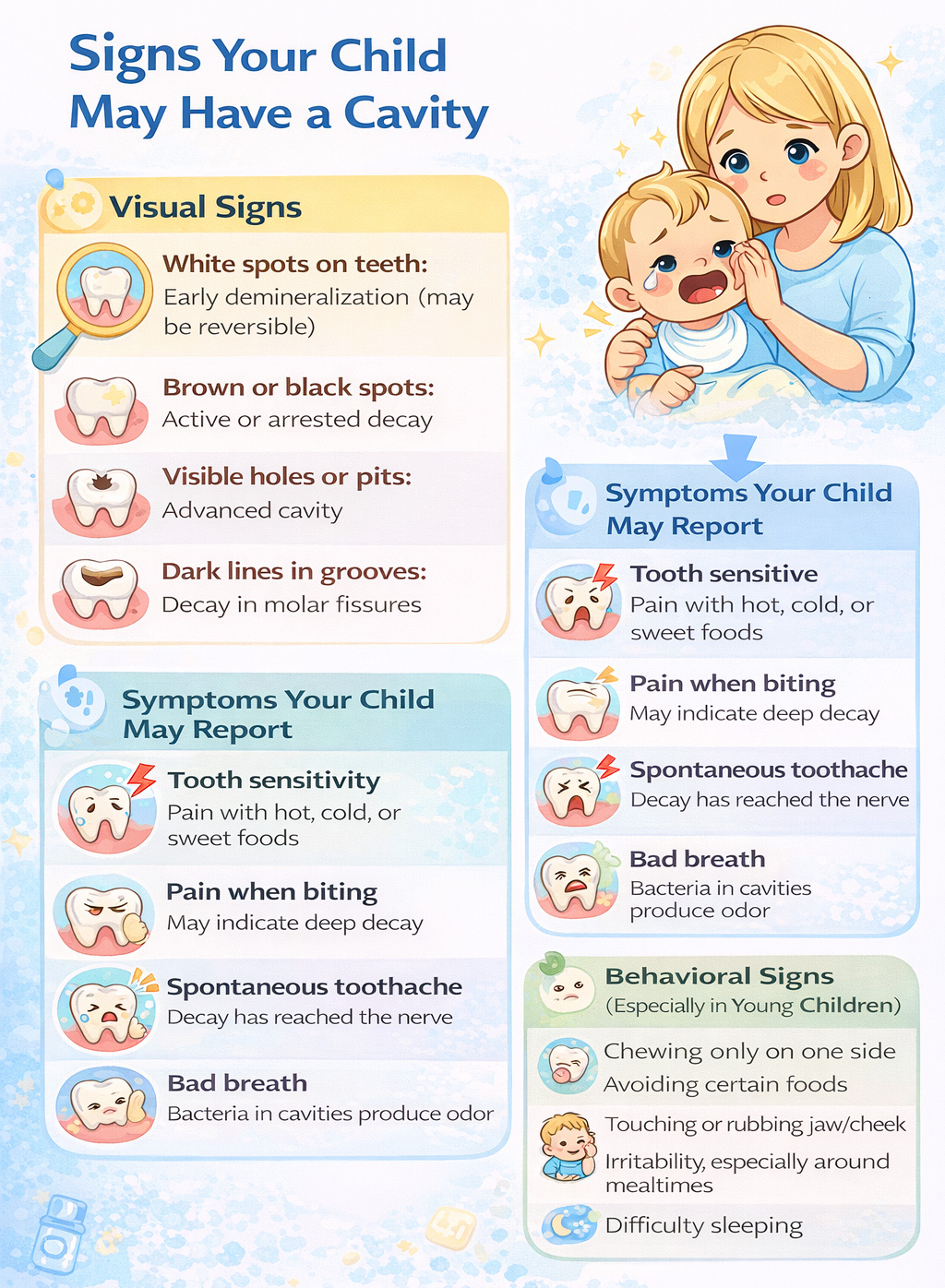
Visual Signs
- White spots on teeth: Early demineralization (may be reversible)
- Brown or black spots: Active or arrested decay
- Visible holes or pits: Advanced cavity
- Dark lines in grooves: Decay in molar fissures
Symptoms Your Child May Report
- Tooth sensitivity: Pain with hot, cold, or sweet foods
- Pain when biting: May indicate deep decay
- Spontaneous toothache: Decay has reached the nerve
- Bad breath: Bacteria in cavities produce odor
Behavioral Signs (Especially in Young Children)
- Chewing only on one side
- Avoiding certain foods
- Touching or rubbing the jaw/cheek
- Irritability, especially around mealtimes
- Difficulty sleeping
⚠️ When to Seek Urgent Care
See a dentist promptly if your child has: facial swelling, fever with tooth pain, severe pain that disrupts sleep or eating, pus or drainage near a tooth, or a visible abscess (bump on gums). These may indicate infection requiring immediate treatment.
Do Cavities in Baby Teeth Really Need to Be Filled?
Yes, in most cases, cavities in baby teeth need treatment.
“They’re just going to fall out anyway” is a common misconception that can lead to serious consequences.
Why Baby Teeth Cavities Matter
- Pain and infection: Untreated cavities cause pain and can lead to abscesses (infections) requiring emergency treatment
- Damage to permanent teeth: Infection in baby teeth can damage permanent teeth developing directly below
- Space loss: If baby teeth are lost early to decay, permanent teeth may come in crooked
- Nutrition problems: Painful teeth make eating difficult, affecting nutrition
- Speech development: Baby teeth are needed for proper speech
- Self-esteem: Visible decay or missing teeth affect confidence
- Spread of decay: Cavity-causing bacteria spread to other teeth
When Observation (Not Treatment) May Be Appropriate
In some specific cases, your dentist may recommend monitoring rather than treating a cavity:
- Very small cavity in a tooth that will fall out within 6 months
- Early-stage decay that may be reversible with fluoride
- Child with medical conditions that make treatment risky
Your pediatric dentist will recommend the best approach based on cavity severity, tooth location, your child’s age, and when the tooth will naturally be lost.
How Are Cavities Treated in Children?
Treatment depends on how deep the cavity is and where it’s located.
Pediatric dentists have multiple options ranging from non-invasive approaches to more comprehensive treatment.
| Treatment | Best For | How It Works |
|---|---|---|
| Fluoride treatment | Very early decay (white spots) | Can remineralize enamel and reverse early cavities |
| Silver Diamine Fluoride (SDF) | Arresting decay, young children, special needs | Painted on to stop decay; no drilling; turns cavity black |
| Filling (composite/tooth-colored) | Small to medium cavities | Decay removed, tooth filled with tooth-colored material |
| Stainless steel crown | Large cavities, after pulpotomy | Pre-formed metal cap covers entire tooth; very durable |
| White crown (zirconia) | Front teeth, cosmetic concern | Tooth-colored alternative to stainless steel |
| Pulpotomy (baby root canal) | Deep decay reaching the pulp | Removes infected pulp tissue; tooth is saved |
| Extraction | Severely damaged teeth, unrestorable | Tooth removed; space maintainer may be needed |
Silver Diamine Fluoride (SDF): A Newer Option
SDF is a liquid that stops cavity progression without drilling or anesthesia. It’s particularly useful for:
- Very young children who can’t tolerate traditional treatment
- Children with special needs or severe dental anxiety
- Multiple cavities needing quick intervention
- Baby teeth that will fall out soon
The main drawback: SDF permanently stains the treated area black. For back teeth this may be acceptable; for front teeth, parents must weigh appearance against the benefits of avoiding sedation or extensive treatment.
Stainless Steel Crowns: Why So Common in Kids?
Parents are often surprised when their child needs a “silver cap” rather than a white filling.
Stainless steel crowns are preferred for baby molars because:
- Durability: They last until the tooth naturally falls out (fillings often fail)
- Full coverage: Protects the entire tooth from further decay
- Placement speed: One visit, less chair time for the child
- Cost-effective: Lower failure rate means less retreatment
White (zirconia) crowns are available as an alternative but may require more tooth reduction and are more expensive.
How to Prevent Cavities in Children
Cavities are almost entirely preventable.
Prevention involves four key strategies that work together:
1. Effective Daily Brushing
- Brush twice daily with fluoride toothpaste
- Parents should brush for children until age 7-8
- Brush for 2 full minutes
- Don’t rinse after brushing—let fluoride work
- Nighttime brushing is most important
2. Fluoride Exposure
Fluoride strengthens enamel and can reverse early decay:
- Fluoride toothpaste: From first tooth (rice grain → pea size at age 3)
- Fluoridated water: NYC tap water contains fluoride
- Professional fluoride varnish: Applied at dental checkups
- Fluoride supplements: If your water isn’t fluoridated (ask your dentist)
3. Limit Sugar Frequency
It’s the frequency of sugar exposure—not just the amount—that matters most.
Each time your child has sugar, acid attacks the teeth for 20+ minutes.
Smart Sugar Strategies
- Limit sugary foods/drinks to mealtimes only
- Avoid sipping juice or milk throughout the day
- Choose water between meals
- If having sweets, eat them all at once rather than slowly over time
- Avoid sticky candies that cling to teeth
- Never put baby to bed with bottle containing anything but water
4. Dental Sealants
Sealants reduce cavity risk by up to 80% in back teeth.
They’re thin protective coatings applied to the chewing surfaces of molars, where most cavities occur.
- When: As soon as permanent molars come in (around age 6 and 12)
- Procedure: Quick, painless, no drilling—takes just minutes
- Duration: Last several years with proper care
- Cost: Much cheaper than fillings; often covered by insurance
5. Regular Dental Checkups
- Every 6 months (or more often if high-risk)
- Professional cleaning removes plaque you can’t
- Fluoride varnish application
- Early detection of problems
- Personalized prevention advice
Clinical Insight
“The single biggest change families can make is eliminating constant sipping and snacking. I see children whose teeth look like they never brush—but when we discuss habits, it turns out they brush twice daily. The problem is the juice box they sip all morning or the crackers they graze on between meals. Each exposure restarts the acid clock. Consolidating eating to defined mealtimes makes a dramatic difference.”
— Dr. Mary G. Trice, DDS
Baby Bottle Tooth Decay (Early Childhood Caries)
Baby bottle tooth decay is severe decay affecting infants and toddlers, typically on the front upper teeth.
It’s caused by prolonged exposure to sugary liquids—most commonly from bottles or sippy cups at bedtime or throughout the day.
Causes of Baby Bottle Decay
- Putting baby to bed with a bottle of milk, formula, or juice
- Prolonged on-demand breastfeeding overnight
- Using a bottle or sippy cup as a pacifier throughout the day
- Dipping pacifiers in honey or sugar
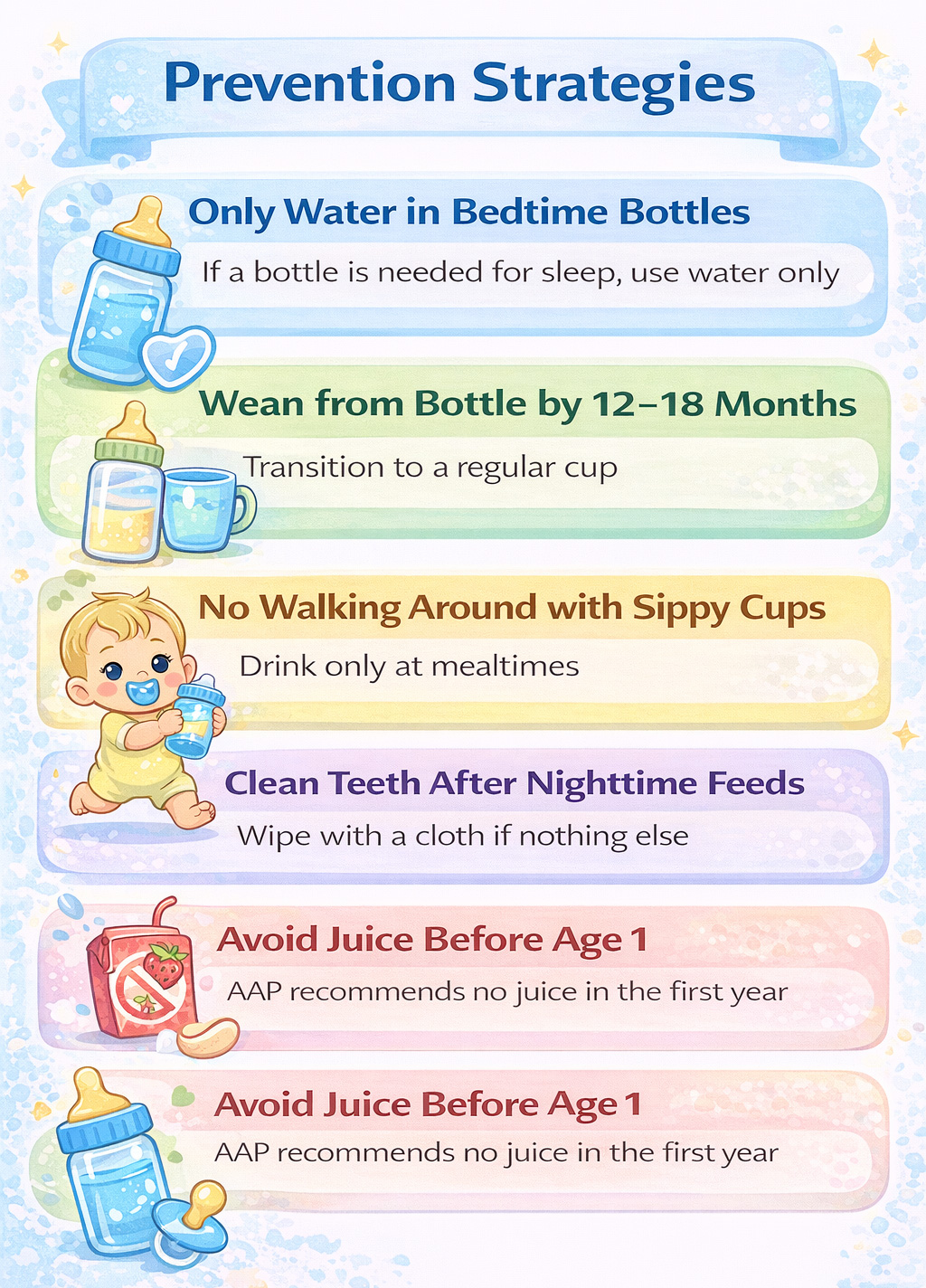
Prevention Strategies
- Only water in bedtime bottles: If your child needs a bottle to sleep, use water only
- Wean from bottle by age 12-18 months: Transition to regular cup
- Don’t let baby walk around with bottle/sippy cup: Drink at mealtimes
- Clean teeth/gums after nighttime feeds: Wipe with cloth if nothing else
- Avoid juice before age 1: AAP recommends no juice in the first year
How Much Do Pediatric Cavity Treatments Cost?
Costs vary by location and complexity, but here are typical ranges:
| Treatment | Typical Cost (Without Insurance) |
|---|---|
| Fluoride varnish | $25-$50 |
| Silver Diamine Fluoride (SDF) | $25-$75 per tooth |
| Dental sealant (per tooth) | $30-$60 |
| Composite filling | $150-$300 |
| Stainless steel crown | $200-$400 |
| Pulpotomy + crown | $300-$500 |
| Extraction (simple) | $75-$200 |
| Space maintainer | $200-$400 |
Most dental insurance covers preventive care (cleanings, fluoride, sealants) at 100% and restorative care (fillings, crowns) at 50-80%.
Medicaid covers dental treatment for children. Learn more about dental insurance for kids →
Frequently Asked Questions About Cavities
My child brushes twice a day—how can they have cavities?
Cavities result from multiple factors beyond just brushing.
Frequent snacking/sipping sugary drinks, natural grooves in teeth, enamel quality, and even which bacteria live in your child’s mouth all play roles.
Also, brushing technique matters—quick or incomplete brushing may miss plaque.
Your dentist can help identify what’s contributing to your child’s specific situation.
Can cavities be reversed without fillings?
Very early cavities (white spots/demineralization) can sometimes be reversed with excellent oral hygiene and fluoride.
Once a cavity has broken through the enamel surface, it cannot heal on its own and requires treatment.
This is why early detection through regular dental visits is so valuable.
Are cavities contagious?
The bacteria that cause cavities (Streptococcus mutans) can be transmitted from person to person, typically from parent to child through saliva sharing—like testing food temperature with your mouth or sharing utensils.
However, having the bacteria doesn’t guarantee cavities; sugar exposure and oral hygiene determine whether decay develops.
Why does my child need a crown instead of a filling?
Stainless steel crowns are recommended when decay is extensive, after pulpotomy (baby root canal), or when the tooth structure is weak.
Unlike adult teeth, baby molars are small with thin enamel, and fillings have high failure rates in primary teeth.
Crowns cover and protect the entire tooth, lasting until it naturally falls out.
What is Silver Diamine Fluoride (SDF)?
SDF is a liquid applied to cavities to stop decay progression without drilling.
It’s painless and quick, making it ideal for young children or those with special needs.
The drawback is that it permanently stains treated areas black.
It’s a great option for back teeth or as a temporary measure, but cosmetically may not be suitable for visible front teeth.
Will my child need sedation for cavity treatment?
Many children tolerate cavity treatment with just local anesthesia (numbing), especially for single fillings.
Sedation may be recommended for very young children, anxious children, those with special needs, or when multiple teeth need treatment.
Options range from mild nitrous oxide (“laughing gas”) to oral sedation to general anesthesia.
Your dentist will recommend the safest, most appropriate approach.
Can breastfeeding cause cavities?
Breast milk alone doesn’t cause cavities—in fact, it contains protective antibodies.
However, prolonged on-demand breastfeeding, especially overnight after teeth have erupted, can contribute to decay because milk contains natural sugars that feed bacteria.
After teeth appear, try to clean gums/teeth after nighttime feeds.
How many cavities is “normal” for kids?
Any cavity is preventable, so the ideal is zero.
However, statistics show 23% of children ages 2-5 and 52% of children ages 6-8 have experienced cavities.
One cavity isn’t cause for alarm, but it indicates your child is cavity-prone and prevention should be intensified to protect other teeth.
Related Guides
Sources & References
- American Academy of Pediatric Dentistry. (2024). Guideline on Restorative Dentistry. AAPD Reference Manual.
- Centers for Disease Control and Prevention. (2024). Dental Caries and Tooth Loss in Adults in the United States. CDC.
- American Dental Association. (2024). Tooth Decay. MouthHealthy.org.
- Crystal YO, et al. (2017). Use of silver diamine fluoride for dental caries management. Journal of the American Dental Association, 148(10), 753-759.
- Wright JT, et al. (2016). Sealants for preventing and arresting pit-and-fissure occlusal caries. Journal of the American Dental Association, 147(8), 672-682.
Medical Disclaimer
This article is for informational purposes only and does not constitute medical advice. Treatment recommendations depend on individual circumstances. Consult with your pediatric dentist for personalized guidance. Information current as of January 2026.

Mary – Queens Pediatric Dental Resource Manager. I’m a dental health researcher and parent advocate based in Queens, NY. After struggling to find reliable pediatric dental information during my own child’s dental emergency, I created this resource to help other Queens families navigate their children’s oral health needs.
I curate evidence-based information from leading pediatric dental organizations, peer-reviewed research, and trusted dental health experts. While I’m not a dentist, I’m committed to providing accurate, practical guidance that helps parents make informed decisions.
All content is thoroughly researched and includes proper medical disclaimers directing families to consult qualified pediatric dentists for their children’s specific needs.