
Reviewed by our dental health editorial team | Last Updated: March 2026
Affiliate disclosure: This article contains Amazon affiliate links. If you purchase through a link on this page, we may earn a small commission at no additional cost to you. Our recommendations are based on safety research, pediatric dental expert input, and hands-on parent testing, not affiliate relationships. Prices may vary.
Signs of teething can appear as early as 10 to 12 weeks of age, according to feeding specialists, though most babies cut their first tooth between 6 and 8 months.
When it happens, the instinct to chew is immediate and relentless, and parents quickly discover that babies will gum anything they can reach, safe or not.
The right teething toy channels that instinct safely, soothes inflamed gums, and supports the oral motor development that underpins speech and feeding skills.
The wrong one poses choking hazards, contains toxic materials, or simply breaks under the pressure of determined little jaws.
This guide covers the six best teething toys for 2026, reviewed with input from pediatric dental professionals, organized by age stage and use case, with a full safety checklist and a clear breakdown of what to buy and what to avoid entirely.
KEY TAKEAWAYS
- Teething begins earlier than most parents expect: Signs of oral exploration and gum sensitivity can appear as early as 10–12 weeks, and the American Academy of Pediatric Dentistry reports that teething typically begins between 6 and 8 months, according to AAPD President Dr. Scott Cashion.
- Material is the most important safety factor: Pediatric dentists consistently recommend teethers made from food-grade silicone or natural rubber, free of BPA, phthalates, PVC, parabens, and synthetic dyes.
- One-piece construction prevents choking: Any teether that can separate into parts, including those with detachable handles, beads, or liquid-filled compartments, poses a choking or aspiration risk and should be avoided.
- Amber teething necklaces are dangerous: The American Academy of Pediatrics and the FDA warn that all teething jewelry poses a choking and strangulation hazard for infants. No exception.
- Chill, never freeze: Chilled teethers from the refrigerator are safe and effective; frozen, solid teethers are too hard and can damage delicate gum tissue. Always refrigerate, never freeze.
Medical disclaimer: This article provides general product information for parents. It does not replace advice from your child's pediatric dentist or pediatrician. If your baby shows signs of unusual gum swelling, high fever, or extreme fussiness during teething, consult your healthcare provider.
What Do Pediatric Dentists Actually Look for in a Teething Toy?
The teething product market is enormous and largely unregulated, meaning the burden of identifying safe products falls on parents.
Pediatric dentists cut through the marketing noise with a short, consistent list of criteria:
| What to Look For | Why It Matters |
|---|---|
| Food-grade silicone or natural rubber | Safe for mouthing; withstands pressure without breaking; easy to sterilize |
| One-piece construction | No detachable parts that can become choking hazards under chewing force |
| BPA, phthalate, PVC, and lead-free certification | Eliminates hormone-disrupting and toxic chemical exposure during oral contact |
| Varied textures (ridges, bumps, nubs) | Different surfaces stimulate different areas of gum tissue and satisfy the baby’s exploratory drive |
| Age-appropriate size | Large enough that it cannot be fully inserted into the mouth or throat; small enough for the baby to grip independently |
| Dishwasher-safe or easy to sterilize | Teethers go into the mouth constantly; they must be cleanable without degrading |
"Look for a toy made of non-toxic and durable material, such as natural rubber, silicone, or wood, and avoid plastics," advises Dr. Shamin Makvandi, principal dentist at DentiFlow Dentistry.
“These materials are safe for babies and can withstand biting and chewing.” Dr. Makvandi also emphasizes that varied textures, bumps, ridges, and grooves are important because “varied surfaces stimulate the gums and emerging teeth,” providing both comfort and developmental input.
Beyond material, the shape of the teether determines where it can reach in the mouth.
Babies need relief in different areas depending on which teeth are coming in: front teeth, first molars, and second molars.
All arrive at different times and require different teether shapes to reach.
Understanding the full baby teeth eruption timeline helps parents select the right teether for the specific stage their baby is in.
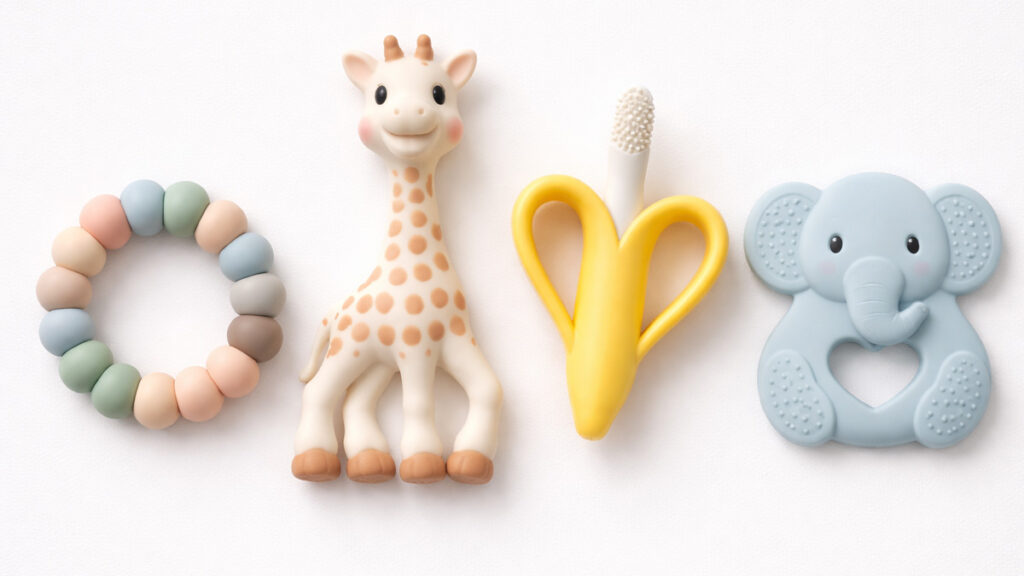
The 6 Best Teething Toys for Babies in 2026
1. Comotomo Silicone Baby Teether Best Overall (Ages 3+ Months)
The Comotomo teether earns near-universal recommendation from pediatric dentists and consistently tops independent testing roundups. Its design is inspired by baby fingers.
The four soft, finger-like protrusions give babies a variety of biting surfaces that mimic the sensation of gnawing on their own hands (the default teething behavior) while delivering safe, structured gum stimulation.
Pediatric orthodontist Dr. Bruce Tasios specifically recommends it to his patients: “It is easy to hold and has a one-piece construction, but, best of all, it has several biting points so the child will never get bored.”
The material is food-grade silicone that is free of BPA, phthalates, plastic, nitrosamines, and lead.
The one-piece design means there is nothing to come apart under chewing force, a critical safety feature.
It is heat-resistant and fully dishwasher-safe.
Both the front gum area and the back gum area can be reached by the angled protrusions, making it suitable across most of the teething sequence. Price approximately $13–$16.
Best for: Babies 3–12 months; babies who chew their fists and fingers; parents who want a dentist-recommended, clean-design teether with strong safety credentials.
2. Baby Banana Infant Training Toothbrush Best Toothbrush-Teether Combo (Ages 3+ Months)
The Baby Banana is uniquely recommended by SheKnows’ expert panel as the top expert-recommended teether of 2025, praised for its dual function: it soothes teething gums through silicone nub bristles while simultaneously introducing the sensation and motion of brushing.
This early exposure to a toothbrush shape builds the neural association between mouth-in-tool and oral hygiene, a habit foundation that pays dividends when brushing time arrives.
Designed by a mother who is also a dental hygienist, the banana shape is easy for little hands to grasp from multiple angles.
The soft silicone bristles and textured bottom provide varied gum stimulation.
It is made from soft medical-grade silicone, free of BPA, latex, and phthalates, and can be refrigerated for a chilling effect or sterilized in a dishwasher. Price approximately $7–$10.
Best for: Babies 3–12 months; parents who want to introduce the concept of tooth brushing during teething; first-time teether buyers looking for maximum value at low cost.
3. Fridababy Not-Too-Cold-To-Hold Teether Best Chillable Teether (Ages 3+ Months)
Cold is one of the most effective natural remedies for inflamed teething gums, but most freezable teethers have a design flaw: they become so cold that a baby cannot comfortably hold them.
Fridababy solves this with an insulated silicone handle that stays at room temperature while the double-sided chillable gum massager provides targeted cold relief.
The massager features four different textures designed to stimulate both front and back gum areas, particularly useful during the first molar stage.
The key pediatric dental guidance on chilled teethers: refrigerate, never freeze.
Frozen-solid teethers are too hard and can damage delicate gum tissue.
The Fridababy teether is specifically designed for the refrigerator, not the freezer.
Made of nontoxic, BPA-free silicone throughout. Price approximately $12–$15.
Best for: Babies in active teething with visibly swollen or inflamed gum tissue; parents whose babies are particularly fussy or sleepless during teething; anyone whose baby rejects standard room-temperature teethers.
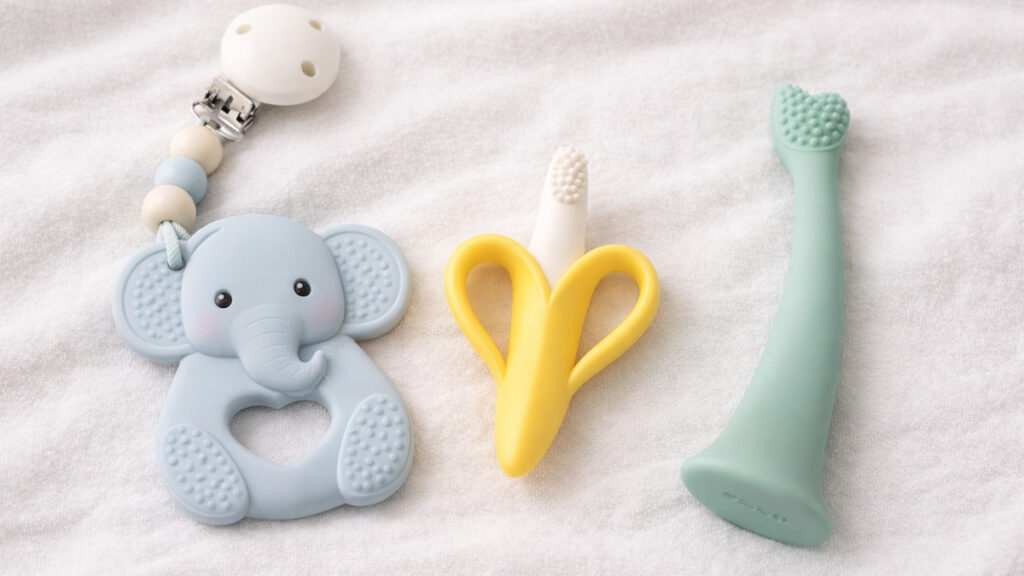
4. Mombella Elephant Teether with Clip Best for On-the-Go (Ages 0–12 Months)
The Mombella elephant teether has a distinctive A-shaped body with a pacifier-like tip featuring teething bumps and four gum-stimulating legs, all in a shape that is easy for small hands to grip in multiple orientations.
What sets it apart practically is the included removable leash and clip, which attaches the teether to clothing, a stroller strap, or a car seat. This eliminates the cycle of drop-and-retrieve that turns every outing into a floor-hygiene anxiety event.
Independent testing by BabyGearLab found the Mombella to be an excellent option for babies who want soothing across both front and back gum areas, with the textured tip reaching teething discomfort in the back of the mouth.
The silicone construction is 100% food-grade, free of BPA, phthalates, lead, cadmium, and PVC. Dishwasher-safe. Price approximately $13–$16.
Best for: Parents on the go, stroller walks, car trips, shopping; babies who drop teethers constantly; newborn through 12-month range makes it useful across the full early teething sequence.
5. Nuby Nananubs Banana Massaging Teether Best Budget Pick (Ages 3+ Months)
The Nuby Nananubs is a compact, banana-shaped silicone teether with a nubbed massaging surface across the entire length.
It is one of the most widely available and consistently well-reviewed budget teethers on the market, appearing in Amazon’s top best-sellers in its category and frequently recommended in pediatric dental office handouts for new parents.
The nub texture covers the surface densely enough to stimulate multiple areas of gum tissue simultaneously. It is BPA-free and dishwasher-safe.
The compact size makes it easy to pack in a diaper bag.
At under $5, it is frequently purchased in multiples so parents can keep one at home, one in the bag, and one in the car. Price approximately $4–$6.
Best for: Budget-conscious families; a backup or travel teether; grandparents’ houses; babies who prefer simpler, lighter teethers over more structured shapes.
6. Green Sprouts Molar Teether Best for Back Teeth (Ages 6+ Months)
Most teethers are designed for front-of-mouth comfort, which is fine for the incisors, but leaves babies without targeted relief when the first molars begin to erupt around 13 to 19 months.
The Green Sprouts Molar Teether is specifically engineered to reach the back of the mouth, with a long, angled stem that extends past the front teeth to massage the molar gum area that standard teethers cannot access.
Made from BPA- and PVC-free silicone, the resistance of the chewing surface also helps strengthen jaw muscles, an oral motor development benefit that feeding specialist Jordyn Koveleski Gorman highlights in her 2026 review, noting that the resistance “helps strengthen your baby’s jaw” during the transition to solid foods.
Suitable from 6 months through toddlerhood. Can be refrigerated for extra relief. Price approximately $13–$15.
Best for: Babies 6 months and older approaching or going through first molar teething; babies who are beginning to eat solid foods; heavy chewers who have outgrown soft front-focused teethers.
Quick Comparison: Best Teething Toys 2026
| Teether | Best For | Age Range | Material | Chillable | Dishwasher Safe | Approx. Price |
|---|---|---|---|---|---|---|
| Comotomo Silicone Teether | Best overall | 3–12 months | Food-grade silicone | Yes (fridge) | Yes | $13–$16 |
| Baby Banana Toothbrush-Teether | Toothbrush intro | 3–12 months | Medical-grade silicone | Yes (fridge) | Yes | $7–$10 |
| Fridababy Not-Too-Cold Teether | Inflamed gums | 3+ months | BPA-free silicone | Yes (fridge only) | Check packaging | $12–$15 |
| Mombella Elephant with Clip | On-the-go | 0–12 months | Food-grade silicone | Yes (fridge) | Yes | $13–$16 |
| Nuby Nananubs Banana | Budget/backup | 3+ months | BPA-free silicone | Yes (fridge) | Yes | $4–$6 |
| Green Sprouts Molar Teether | Back molar pain | 6 months+ | BPA/PVC-free silicone | Yes (fridge) | Yes | $13–$15 |
Teething Toys to Avoid: What Pediatric Dentists Say Is Not Safe
The dangerous product list is as important as the recommended one.
Several popular-sounding teething products are explicitly warned against by the American Academy of Pediatrics, the FDA, and pediatric dental professionals:
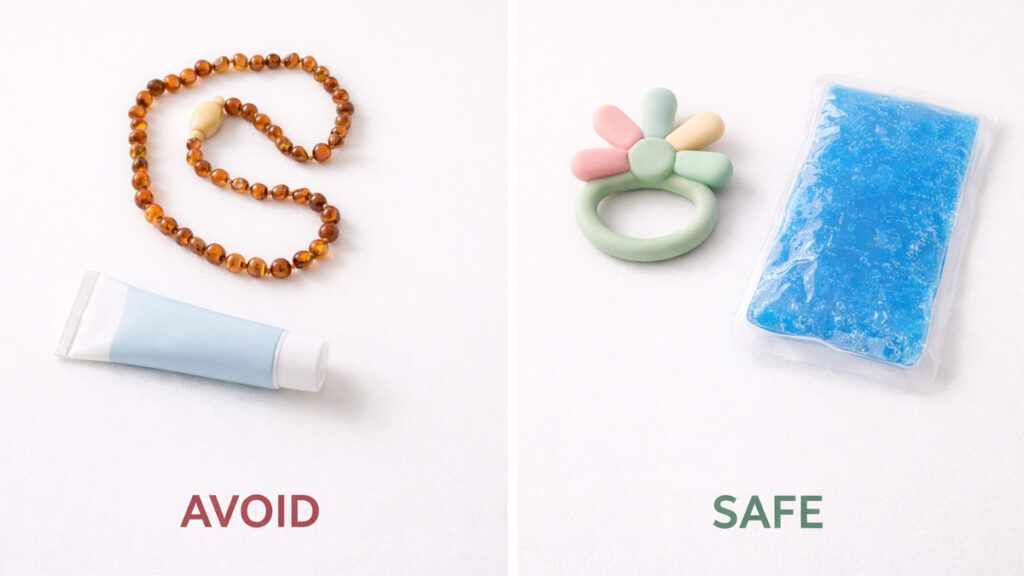
Amber Teething Necklaces: A Hard No
Amber teething necklaces are marketed as a natural remedy that releases succinic acid through the skin to reduce teething pain.
There is no clinical evidence supporting this mechanism.
What is thoroughly evidenced is the risk: the AAP and FDA warn that all teething jewelry, including amber, silicone bead, and wooden bead necklaces, poses a choking risk if a bead breaks off and a strangulation risk if the necklace catches on something while the baby sleeps.
No teething benefit justifies these hazards. The FDA has issued specific warnings advising parents not to use any teething jewelry on infants.
Our guide to dangerous dental trends affecting children covers amber necklaces and other viral teething products that circulate on social media with safety claims that are not supported by clinical evidence.
Benzocaine and Lidocaine Gels Recalled as Unsafe for Infants
Over-the-counter numbing gels containing benzocaine (such as Baby Orajel) are no longer considered safe for children under age 2.
The FDA warns that benzocaine can cause methemoglobinemia, a rare but potentially fatal condition in which the blood’s ability to carry oxygen is severely reduced.
The AAP recommends against all topical anesthetic use for infant teething.
Stick to physical methods: chilled teethers, cold washcloths, and gentle gum massage.
Liquid-Filled Teethers and Teethers with Detachable Parts
Teethers with liquid-filled chambers can break under chewing pressure, releasing the liquid, which may not be sterile or safe to ingest.
Any teether with detachable handles, removable components, or a multi-piece assembly fails the one-piece safety rule.
If a teether can come apart in your hands when you pull on it, it can come apart in your baby’s mouth.
Frozen Teethers
Solid-frozen teethers are too hard for infant gum tissue and can cause bruising and pain rather than relief.
Always refrigerate, never freeze.
If a teether package says “freeze for relief,” disregard the instruction refrigerate it instead.
How Teething Toys Support Oral Development Beyond Pain Relief
Teething toys serve a developmental function that goes beyond comfort.
Feeding specialist Jordyn Koveleski Gorman, whose 2026 review is widely cited among pediatric occupational therapists, explains that “using baby teething toys is a critical part of oral motor development.”
Teethers provide oral sensory input that helps regulate the baby’s sensory system, introduce varied textures that prepare the mouth for solid food, and build the jaw strength and tongue lateralization skills that underpin both chewing and early speech.
Introducing teethers around 3 months of age, before the first tooth appears, begins this sensory exposure process early.
Babies who experience varied oral textures through teethers during the pre-tooth phase tend to be less resistant to new food textures and to toothbrushing when those transitions arrive.
The Baby Banana toothbrush-teether is specifically designed to take advantage of this window: introducing the feel of a bristled surface during teething creates a positive association with oral tools that makes the move to actual toothbrushing smoother.
When the first teeth do arrive, maintaining them properly from day one is essential, as cavities in baby teeth are not trivial, and the habits formed in infancy persist.
Our guide to preventing cavities in children covers the first-tooth brushing protocol, fluoride use from infancy, and the dietary factors that affect enamel from the moment teeth emerge.
How to Clean and Maintain Teething Toys
A teether that goes into a baby’s mouth every few minutes can become a bacterial reservoir quickly if not cleaned regularly.
The cleaning protocol is simple but must be followed consistently:
- Before the first use: Wash with warm soapy water or run through the dishwasher, even if the teether came sealed in packaging.
- Daily cleaning: Wash with mild soap and warm water, or place in the top rack of the dishwasher. Silicone teethers can also be sterilized with bottle sterilizers.
- After floor contact: Any teether that falls on the floor in the house or outside should be cleaned before being returned to the baby. The parent-licking-the-teether method is not recommended, as adult oral bacteria can be transferred to the infant.
- Inspect regularly: Check teethers weekly for cracks, tears, discoloration, or any signs of material degradation. Silicone that is cracking or tearing should be discarded immediately. Degraded material can harbor bacteria and produce small particles that a baby can ingest.
- Replace at the first sign of damage: At $5–$16 per teether, replacement is far cheaper than the risk of a baby ingesting a material fragment.
Consistent oral hygiene habits start during teething, not when the first tooth appears.
Beginning to clean your baby’s gums with a soft washcloth before teeth arrive, then transitioning to a soft infant toothbrush at the first tooth, creates continuity that makes brushing feel normal rather than new.
Our complete guide to baby teeth development covers the eruption sequence and the brushing milestones that correspond to each stage.
The Bottom Line on Teething Toys for Babies
For most babies from 3 months through the first year, the Comotomo Silicone Teether is the strongest all-around choice, dentist-recommended, one-piece, food-grade silicone, and effective across both front and back gum areas.
The Baby Banana is the best value pick and the only teether that doubles as a brushing introduction tool.
For babies in active molar teething, the Green Sprouts Molar Teether provides targeted back-of-mouth relief that no standard teether can.
For parents on the go, the Mombella’s clip attachment solves the constant-dropping problem.
Whatever you choose, the non-negotiables are one-piece construction, BPA-free food-grade material, and refrigerator-chillable design.
And skip the amber necklaces entirely, no debate there.
Frequently Asked Questions About Teething Toys
When should I start using a teething toy?
You can introduce soft, lightweight teethers as early as 3 months of age, when babies begin actively bringing their hands to their mouths and showing oral exploration behaviors.
You do not need to wait for visible signs of teeth; the sensory and oral motor development benefits begin before teething does.
Choose a very soft, lightweight teether for this early stage, such as a silicone ring or the Baby Banana.
How long does teething last?
Active teething, the period when teeth are actively cutting through the gum, can last a few days per tooth, though gum sensitivity in the area can persist longer.
The full primary dentition of 20 baby teeth typically finishes erupting by age 2 to 3.
The most significant teething discomfort usually occurs with the first tooth (around 6 months) and with the first molars (around 13–19 months).
The second molars, arriving around 23–33 months, are often the most painful because of their larger surface area.
Is it okay to refrigerate a teether?
Yes refrigerating a teether is safe and one of the most effective ways to provide gum relief.
The cool temperature helps reduce inflammation and numbs discomfort.
The key rule: refrigerate, never freeze. Frozen-solid teethers are too hard for infant gum tissue and can cause bruising. If your teether instructions say to freeze it, ignore that guidance and chill it in the refrigerator instead.
My baby prefers chewing on my finger over any teether. Is that okay?
Completely normal, many babies prefer the warmth, pressure, and familiar feel of a parent’s clean finger over a teether.
This is safe in small doses when your hands are clean.
The goal of a teether is to provide a safe, hygienic alternative that does not require constant parental involvement.
Try warming the teether slightly in your hand before offering it, or dipping it in breast milk to increase acceptance.
Do teething toys help with first dental visits?
Yes, indirectly. Babies who have had positive, varied oral sensory experiences through teethers and especially those who have been introduced to brushing through a toothbrush-teether like the Baby Banana tend to be more tolerant of having their mouths examined by a dentist.
The first dental visit is recommended by age 1 or within 6 months of the first tooth appearing.
Starting teething toys early and transitioning to brushing on schedule creates the oral tolerance that makes that first visit go smoothly.
Sources
- Smile Valley Pediatric Dentistry 8 Best Baby Teething Toys, According to a Pediatric Dentist (Dr. Roya Pilcher, DMD)
- SheKnows The 7 Best Teethers for Babies According to Dentists (featuring AAPD President Dr. Scott Cashion and Dr. Shamin Makvandi)
- Mommyhood101 Best Baby Teething Toys 2026, Tested and Reviewed (Updated February 2026)
- Eat Play Say Best Baby Teethers: Feeding Specialist Reviews (Jordyn Koveleski Gorman, Updated February 2026)
- BabyGearLab The Best Baby Teether Toy: Tested and Ranked
- Lolo Children’s Dentist What Teething Toys Are Safe According to Pediatric Dentists? (2025)
- Hopscotch Children’s Dentistry Best Teething Toys for Babies: Safe Relief for Sore Gums

Mary – Queens Pediatric Dental Resource Manager. I’m a dental health researcher and parent advocate based in Queens, NY. After struggling to find reliable pediatric dental information during my own child’s dental emergency, I created this resource to help other Queens families navigate their children’s oral health needs.
I curate evidence-based information from leading pediatric dental organizations, peer-reviewed research, and trusted dental health experts. While I’m not a dentist, I’m committed to providing accurate, practical guidance that helps parents make informed decisions.
All content is thoroughly researched and includes proper medical disclaimers directing families to consult qualified pediatric dentists for their children’s specific needs.