
Quick Answer
Babies typically get their first tooth around 6 months of age, with all 20 primary (baby) teeth usually appearing by age 3. Children begin losing baby teeth around age 6, with the last baby teeth falling out between ages 10-12. While there’s a general order to tooth eruption and loss, every child’s timeline varies—and most variations are completely normal.
Key Takeaways
- ✓ First tooth typically appears around 6 months (normal range: 4-15 months)
- ✓ All 20 baby teeth usually erupt by age 2.5-3 years
- ✓ Lower central incisors (bottom front teeth) typically come in first
- ✓ Children start losing baby teeth around age 6, finishing by age 12
- ✓ Baby teeth are essential placeholders for permanent teeth
- ✓ Late teething (after 12 months) is usually normal but worth mentioning to your dentist
Understanding Baby Teeth: Why Primary Teeth Matter
Baby teeth (also called primary teeth, deciduous teeth, or milk teeth) are far more important than many parents realize.
While they eventually fall out, these 20 teeth serve critical functions during your child’s first decade of life.
Why Baby Teeth Are So Important
Baby teeth aren’t just temporary placeholders.
According to the American Academy of Pediatric Dentistry (AAPD), primary teeth:
- Guide permanent teeth into position: Baby teeth hold space in the jaw for adult teeth developing beneath the gums
- Enable proper nutrition: Children need teeth to chew food properly and get adequate nutrition
- Support speech development: Teeth help children form sounds correctly, especially “th,” “s,” and “f” sounds
- Shape facial structure: Primary teeth help the jaw and facial bones develop properly
- Build self-esteem: A healthy smile matters for social development and confidence
When baby teeth are lost prematurely due to decay or injury, it can cause surrounding teeth to shift, leading to crowding and alignment problems when permanent teeth come in.
This often results in the need for orthodontic treatment later.
When Do Baby Teeth Come In? Complete Eruption Timeline
Most babies get their first tooth between 4-7 months of age, with the lower central incisors (bottom front teeth) typically appearing first.
By age 3, most children have all 20 primary teeth.
However, there’s significant variation in timing—some babies are born with teeth (natal teeth), while others don’t get their first tooth until after their first birthday.
Baby Teeth Eruption Chart
| Tooth Type | Upper Teeth Erupt | Lower Teeth Erupt | Number of Teeth |
|---|---|---|---|
| Central Incisors (front teeth) | 8-12 months | 6-10 months | 4 |
| Lateral Incisors (next to front teeth) | 9-13 months | 10-16 months | 4 |
| First Molars | 13-19 months | 14-18 months | 4 |
| Canines (cuspids/”fangs”) | 16-22 months | 17-23 months | 4 |
| Second Molars | 25-33 months | 23-31 months | 4 |
| TOTAL | Complete by age 2.5-3 years | 20 | |
Typical Eruption Order (What Comes First)
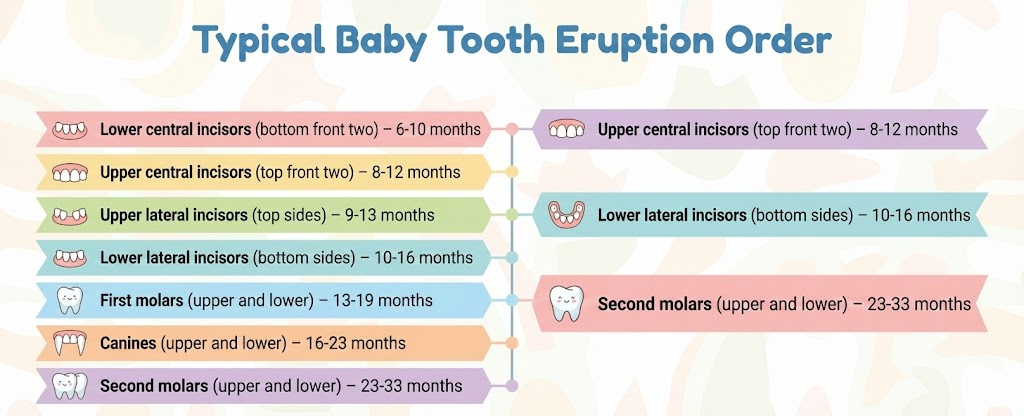
While every child is different, baby teeth typically appear in this general order:
- Lower central incisors (bottom front two) — 6-10 months
- Upper central incisors (top front two) — 8-12 months
- Upper lateral incisors (top sides) — 9-13 months
- Lower lateral incisors (bottom sides) — 10-16 months
- First molars (upper and lower) — 13-19 months
- Canines (upper and lower) — 16-23 months
- Second molars (upper and lower) — 23-33 months
Clinical Insight
“I often see parents worried because their neighbor’s baby got teeth at 4 months while their own 10-month-old is still toothless. In my experience, the timing of tooth eruption has no correlation with overall health or development. I’ve seen perfectly healthy babies get their first tooth anywhere from 3 months to 15 months. What matters more is the pattern—teeth should generally appear in pairs (both lower front teeth together, etc.).”
— Dr. Mary G. Trice, DDS
Teething: Signs, Symptoms, and Relief
Teething is the process of baby teeth breaking through the gums, and it can begin as early as 3 months or as late as 12 months.
Most babies experience some discomfort, but the severity varies greatly from child to child—and even from tooth to tooth in the same child.
Common Teething Symptoms
According to the American Academy of Pediatrics, these are legitimate teething symptoms:
- Increased drooling: Often starts 1-2 months before the first tooth appears
- Gum swelling and tenderness: Gums may look red or puffy where teeth are coming in
- Chewing on everything: Counter-pressure helps relieve gum discomfort
- Irritability: Fussiness, especially in the days before a tooth erupts
- Disrupted sleep: Pain may wake babies during naps or at night
- Decreased appetite: Sucking or chewing may hurt tender gums
- Ear pulling or cheek rubbing: Pain can radiate to these areas
- Low-grade temperature: Slight increase (under 100.4°F/38°C)
⚠️ What Teething Does NOT Cause
Contrary to popular belief, teething does not cause high fever (over 100.4°F), diarrhea, vomiting, rashes on the body, or excessive crying for hours. If your baby has these symptoms, consult your pediatrician—they likely indicate illness, not teething.
Safe Teething Relief Methods
The FDA and AAP recommend these safe approaches for teething discomfort:
| ✓ Safe Methods | How to Use |
|---|---|
| Chilled teething ring | Refrigerate (don’t freeze) solid rubber teething rings; cold numbs gums |
| Cold washcloth | Wet a clean washcloth, chill in refrigerator, let baby chew on it |
| Gum massage | Use clean finger to gently rub baby’s gums with light pressure |
| Chilled foods (6+ months) | Cold fruit in mesh feeder; refrigerated cucumber or carrot (supervised) |
| Pain medication | Infant acetaminophen or ibuprofen (6+ months) per pediatrician guidance |
| ✗ Avoid These (FDA Warnings) | Why |
|---|---|
| Benzocaine gels (Orajel, Anbesol) | Can cause methemoglobinemia, a dangerous blood condition |
| Homeopathic teething tablets | FDA found inconsistent belladonna levels; linked to infant deaths |
| Amber teething necklaces | Choking and strangulation hazard; no proven benefit |
| Lidocaine products | Can cause seizures and heart problems in babies |
| Frozen teethers | Too hard and cold; can damage gums (chilled is fine, frozen is not) |
Which Teeth Hurt Most When Coming In?
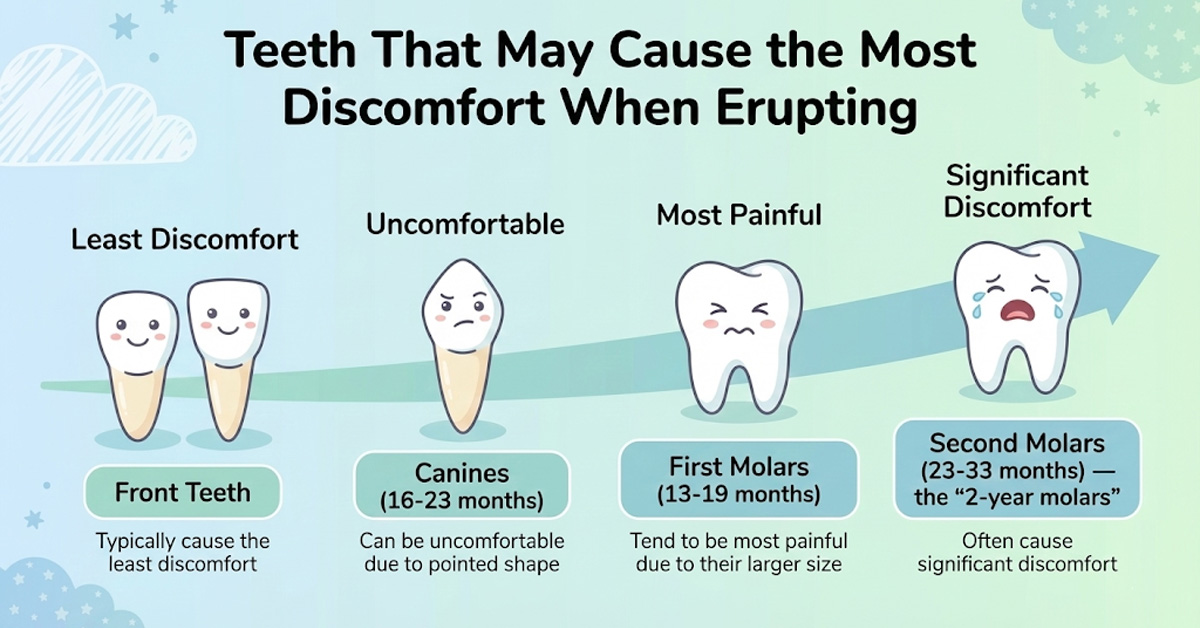
Not all teeth cause equal discomfort. Parents often report that:
- First molars (13-19 months) tend to be most painful due to their larger size
- Canines (16-23 months) can also be uncomfortable due to their pointed shape
- Second molars (23-33 months) often cause significant discomfort—the “2-year molars”
- Front teeth typically cause the least discomfort
When Do Children Lose Baby Teeth?
Children typically begin losing baby teeth around age 6 and finish around age 12.
The process of losing baby teeth and getting permanent teeth is called exfoliation.
Generally, teeth fall out in the same order they came in—bottom front teeth first, then top front teeth, and so on.
When Baby Teeth Fall Out: Complete Chart
| Tooth Type | Upper Teeth Lost | Lower Teeth Lost |
|---|---|---|
| Central Incisors | 6-7 years | 6-7 years |
| Lateral Incisors | 7-8 years | 7-8 years |
| Canines | 10-12 years | 9-12 years |
| First Molars | 9-11 years | 9-11 years |
| Second Molars | 10-12 years | 10-12 years |
What to Expect When Baby Teeth Fall Out
The natural process of losing baby teeth follows a predictable pattern:
- Root absorption: The permanent tooth developing below “dissolves” the baby tooth’s root
- Loosening: With little root left, the baby tooth becomes wiggly (this phase can last weeks)
- Falling out: The tooth falls out on its own or with gentle wiggling
- Eruption: The permanent tooth emerges in its place (may take weeks to months)
Should You Pull a Loose Baby Tooth?
Generally, it’s best to let baby teeth fall out naturally.
A tooth that’s truly ready will come out with minimal effort.
Forcing a tooth that’s not ready can cause pain, bleeding, and potential infection.
However, if a tooth is extremely loose and “hanging by a thread,” gentle wiggling is usually fine.
💡 Pro Tip
If your child swallows a baby tooth (very common!), don’t worry—it will pass harmlessly. Just assure them the Tooth Fairy understands and will still visit.
Shark Teeth: When Permanent Teeth Come In Behind Baby Teeth
“Shark teeth” occur when permanent teeth erupt behind baby teeth that haven’t fallen out yet, creating a double row of teeth.
This happens in about 10% of children and is most common with the lower front teeth.
Despite the alarming appearance, it’s usually not a dental emergency.
What Causes Shark Teeth?
- The permanent tooth comes in at a slight angle, missing the baby tooth root
- The baby tooth root doesn’t dissolve properly
- Crowding in the jaw doesn’t leave room for proper positioning
What to Do About Shark Teeth
- Wait and watch: Often the baby tooth will loosen and fall out within a few weeks once the permanent tooth is erupting
- Encourage wiggling: Have your child gently wiggle the baby tooth several times a day
- See your dentist: If the baby tooth hasn’t fallen out after 2-3 weeks, your pediatric dentist may recommend extraction
Once the baby tooth is out, the tongue typically pushes the permanent tooth forward into proper position over several weeks.
Common Baby Teeth Concerns (and When to Worry)
Late Teething: My Baby Has No Teeth Yet
Late teething (no teeth by 12-13 months) is usually normal but should be mentioned to your pediatric dentist.
According to the AAPD, there’s typically no cause for concern unless no teeth have appeared by 18 months.
Factors that can cause delayed teething include genetics (if parents were late teethers), premature birth, and low birth weight.
Early Teething and Natal Teeth
Some babies are born with teeth (natal teeth) or develop them in the first month (neonatal teeth).
This occurs in about 1 in 2,000-3,000 births.
Natal teeth may need to be removed if they:
- Are very loose (aspiration risk)
- Interfere with breastfeeding
- Cause injury to the baby’s tongue
Gaps Between Baby Teeth
Spaces between baby teeth are actually a GOOD sign.
Permanent teeth are larger than baby teeth, so gaps indicate there will likely be enough room for adult teeth.
Crowded baby teeth with no spaces often predict crowding with permanent teeth.
Discolored Baby Teeth
| Color | Possible Cause | Action Needed |
|---|---|---|
| Yellow | Plaque buildup, thin enamel, certain medications | Improve brushing; see dentist |
| Gray/Dark | Trauma (blood vessels damaged); may indicate dying tooth | See dentist soon for evaluation |
| Brown | Decay, iron supplements, trauma | See dentist to determine cause |
| White spots | Early decay (demineralization) or fluorosis | See dentist—early decay may be reversible |
| Black line at gum | Iron supplements (harmless staining) | Cosmetic only; professional cleaning removes |
Clinical Insight
“A gray tooth after a fall is one of the most common concerns I see. The discoloration happens because blood from damaged vessels seeps into the tooth. Interestingly, about half of these teeth will return to normal color over several months as the blood reabsorbs. The other half stay dark but remain healthy. Either way, the tooth usually doesn’t need treatment unless other symptoms develop.”
— Dr. Mary G. Trice, DDS
Crooked Baby Teeth
Crooked baby teeth don’t necessarily mean permanent teeth will be crooked.
Baby teeth and permanent teeth erupt independently.
However, severe crowding or significant bite problems in baby teeth may warrant early orthodontic evaluation (around age 7).
Teeth Grinding (Bruxism)
Teeth grinding is extremely common in children—up to 30% grind their teeth at some point.
Most children outgrow it by age 6-9. Causes may include:
- Teething discomfort
- Bite misalignment
- Stress or anxiety
- Response to ear pain or illness
Treatment for baby teeth grinding is rarely necessary.
Your dentist will monitor for excessive wear and recommend a night guard only if significant damage is occurring.
How to Care for Baby Teeth at Each Stage
Before Teeth Emerge (0-6 months)
- Wipe gums with soft, damp cloth after feedings
- Avoid putting baby to bed with bottle (except water)
- Schedule first dental visit by age 1
First Teeth (6-12 months)
- Begin brushing with soft infant toothbrush
- Use rice-grain-sized smear of fluoride toothpaste
- Brush twice daily—morning and before bed
Toddler Teeth (1-3 years)
- Continue rice-grain amount of fluoride toothpaste until age 3
- Begin flossing when teeth touch (usually around age 2-3)
- Wean from bottle by 12-18 months
- Limit juice; offer water between meals
Preschool Teeth (3-6 years)
- Increase to pea-sized amount of fluoride toothpaste
- Supervise brushing (parents should do final “check brush”)
- Consider dental sealants on molars
- Establish 2x yearly dental checkups
For complete brushing guidance, see our How to Brush Baby’s Teeth guide.
The Transition to Permanent Teeth
Children get 32 permanent teeth compared to just 20 baby teeth.
The “extra” 12 teeth (including wisdom teeth) erupt in spaces that grow as the jaw develops.
Permanent Teeth Timeline
| Permanent Tooth | Age of Eruption |
|---|---|
| First molars (“6-year molars”) | 6-7 years |
| Central incisors | 6-8 years |
| Lateral incisors | 7-9 years |
| Canines | 9-12 years |
| Premolars (replacing baby molars) | 10-12 years |
| Second molars (“12-year molars”) | 11-13 years |
| Third molars (wisdom teeth) | 17-25 years |
Why New Permanent Teeth Look Yellow
Parents often worry when permanent teeth come in looking more yellow than baby teeth.
This is completely normal. Permanent teeth have more dentin (the yellow layer under enamel) than baby teeth, making them naturally appear more yellow.
The color difference is most noticeable when adult teeth are next to remaining baby teeth.
Why Permanent Teeth Look So Big
New permanent front teeth often look enormous in a child’s mouth—sometimes called the “awkward stage.”
This is normal! The child’s face and jaw will grow to match the teeth.
By adolescence, the proportions balance out.
Frequently Asked Questions About Baby Teeth
How many baby teeth do children have?
Children have 20 baby teeth total: 10 on top and 10 on bottom.
This includes 8 incisors (front teeth), 4 canines (pointed teeth), and 8 molars (back teeth).
These 20 teeth are eventually replaced by 32 permanent teeth.
What if my baby was born with teeth?
Natal teeth (teeth present at birth) occur in about 1 in 2,000-3,000 births.
Most are actual baby teeth that erupted early, though some are extra teeth.
Your pediatric dentist will evaluate whether they need removal based on stability and any problems with feeding.
If the teeth are stable and not causing issues, they’re typically left in place.
Is it normal for babies to grind their teeth?
Yes, teeth grinding (bruxism) is very common in babies and toddlers, affecting up to 30% of children.
It often starts when the first teeth come in and usually stops by age 6.
The grinding sound can be alarming, but it rarely causes damage to baby teeth.
Most children outgrow it without any treatment.
My toddler fell and knocked a baby tooth loose. What should I do?
If a baby tooth is slightly loose after a fall, it will often tighten back up on its own.
Feed soft foods and avoid wiggling the tooth.
If the tooth is very loose, pushed into the gum, knocked out completely, or your child is in significant pain, see a pediatric dentist right away.
Unlike permanent teeth, knocked-out baby teeth should NOT be reimplanted.
Do cavities in baby teeth need to be filled?
Yes, in most cases. Untreated cavities can cause pain, infection, and damage to developing permanent teeth below.
However, very small cavities in baby teeth that are about to fall out may be monitored rather than filled.
Your pediatric dentist will recommend the best approach based on the cavity’s severity and how soon the tooth will naturally be lost.
Why is there a big gap between my child’s front teeth?
A gap between the upper front teeth is very common in children and usually closes on its own when the permanent canine teeth come in around age 11-12.
These canines push the front teeth together.
If the gap persists into the teen years, orthodontic treatment can close it, but it’s rarely something to address during the baby teeth stage.
When should I be concerned about late teething?
Mention late teething to your pediatric dentist if your child has no teeth by 12-13 months, but there’s typically no cause for concern unless no teeth have appeared by 18 months.
Late teething runs in families—if you or your partner were late teethers, your child likely will be too.
Premature babies often teethe later based on their adjusted age.
My child lost a baby tooth early. Will they need a space maintainer?
Possibly. When baby teeth are lost prematurely (due to decay or injury), the surrounding teeth may drift into the empty space, causing crowding when permanent teeth try to come in.
A space maintainer holds the space open until the permanent tooth is ready.
Whether one is needed depends on which tooth was lost, your child’s age, and how soon the permanent tooth will erupt.
When to See a Pediatric Dentist About Baby Teeth
Schedule an appointment if you notice:
- No teeth by 12-13 months (routine checkup)
- No teeth by 18 months (evaluation recommended)
- Teeth coming in very crooked or in unusual positions
- Tooth turned gray or dark after injury
- White, brown, or black spots on teeth
- Teeth that appear unusually shaped or sized
- Shark teeth (permanent teeth behind baby teeth)
- Baby tooth not loosening when permanent tooth is visible
- Severe pain or swelling
- Trauma to the mouth or teeth
Remember, all children should see a pediatric dentist by age 1 and every 6 months thereafter for routine monitoring of tooth development. Learn more about your child’s first dental visit →
Related Guides
Continue learning about your child’s dental health:
- Your Child’s First Dental Visit: Complete Guide
- How to Brush Baby’s Teeth: Age-by-Age Guide
- Teething Remedies: What’s Safe and What Works
- Preventing Cavities in Children
- Space Maintainers: When Your Child Needs One
- Dental Emergencies: What to Do When Baby Teeth Get Injured
Sources & References
- American Academy of Pediatric Dentistry. (2024). Guideline on Management of the Developing Dentition and Occlusion in Pediatric Dentistry. AAPD Reference Manual.
- American Academy of Pediatrics. (2024). Teething: 4 to 7 Months. HealthyChildren.org.
- American Dental Association. (2024). Eruption Charts. MouthHealthy.org.
- U.S. Food and Drug Administration. (2023). Safely Soothing Teething Pain and Sensory Needs in Babies and Older Children. FDA Consumer Updates.
- Memarpour M, et al. (2015). Signs and symptoms associated with primary tooth eruption: a meta-analysis. Pediatrics, 135(1), e107-e115.
Medical Disclaimer
This article is for informational purposes only and does not constitute medical advice. Every child’s dental development is unique. Always consult with a qualified pediatric dentist for guidance specific to your child’s needs. Information is current as of January 2026.

Mary – Queens Pediatric Dental Resource Manager. I’m a dental health researcher and parent advocate based in Queens, NY. After struggling to find reliable pediatric dental information during my own child’s dental emergency, I created this resource to help other Queens families navigate their children’s oral health needs.
I curate evidence-based information from leading pediatric dental organizations, peer-reviewed research, and trusted dental health experts. While I’m not a dentist, I’m committed to providing accurate, practical guidance that helps parents make informed decisions.
All content is thoroughly researched and includes proper medical disclaimers directing families to consult qualified pediatric dentists for their children’s specific needs.