
A major new study from the University of Copenhagen, the largest of its kind ever conducted, has found that children with numerous tooth cavities had up to a 45% higher incidence of heart attack, stroke, and coronary artery disease as adults compared to children with healthier teeth.
The study tracked 568,778 individuals from childhood into adulthood and compared pediatric dental records to adult cardiovascular outcomes.
For Queens parents who have ever wondered whether their child’s cavities really matter, especially baby teeth, this research is a striking answer: childhood oral health appears to have consequences that extend decades into the future.
WHAT YOU NEED TO KNOW
- What the study found: Children with many cavities had up to 45% higher incidence of cardiovascular disease as adults. Children with severe gum disease had up to 41% higher incidence of cardiovascular disease and up to 87% higher incidence of type 2 diabetes.
- Who was studied: 568,778 individuals born 1963–1972 in Denmark, tracked from childhood dental records through adult health outcomes to 2018 (ages 30–56).
- Important caveat: This is a correlation study. It shows a strong association, but cannot prove that cavities directly cause heart disease. Shared lifestyle and socioeconomic factors likely play a role.
- Who conducted it: Lead author Nikoline Nygaard, postdoctoral researcher, University of Copenhagen Department of Odontology. Published in the International Journal of Cardiology, January 2026.
- What it means for parents: Treating and preventing childhood cavities is not just about your child’s teeth; it may matter for their long-term whole-body health.
What the Study Found: The Full Picture
Researchers at the University of Copenhagen analyzed dental health records from more than 568,000 Danish individuals captured in the National Child Odontology Registry between 1972 and 1987, then cross-referenced those records with adult cardiovascular disease outcomes from the National Patient Register tracked through 2018.
This is the first nationwide cohort study to link childhood oral health to adult atherosclerotic cardiovascular disease (ASCVD) incidence using population-level registry data.
The results were striking across every measure examined:
- Girls with the highest number of cavities had a 45% higher incidence of cardiovascular disease in adulthood compared to girls with few cavities.
- Boys with 13–16 teeth affected by cavities had a 32% higher incidence of ASCVD in adulthood compared to boys with only 0–4 teeth affected.
- Children with severe gingivitis (gum disease) had up to a 41% higher incidence of cardiovascular disease, specifically 21% higher in boys and 31% higher in girls.
- During follow-up, 10,049 men and 5,705 women in the study cohort developed cardiovascular disease as adults.
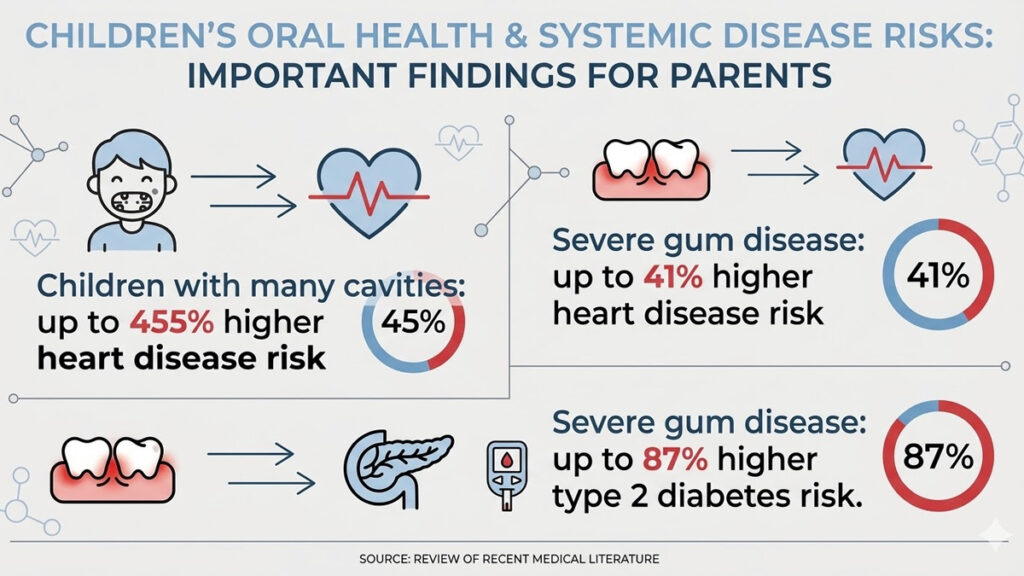
A companion study by the same research team examined the link between childhood oral health and type 2 diabetes and found an equally significant pattern: children with severe gum disease had up to an 87% higher incidence of type 2 diabetes in adulthood, while children with multiple tooth cavities had a 19% higher incidence.
The researchers adjusted their results for educational level, a known proxy for socioeconomic status and lifestyle differences, and also adjusted for the presence of type 2 diabetes, which is itself a risk factor for cardiovascular disease.
Even after these adjustments, the associations between childhood oral health and adult cardiovascular outcomes remained significant.
To understand what causes cavities in children and how to prevent them from developing in the first place, see our complete guide to cavities in children.
Why Do Childhood Cavities Affect the Heart? The Inflammation Theory
The study identifies correlation, not causation.
The researchers are careful to note that they cannot prove cavities directly cause heart disease.
But the biological mechanism behind the association is increasingly well-supported by independent research.
Lead author Nikoline Nygaard stated: “We suspect that exposure to high levels of inflammation in the form of gum disease and dental caries already in childhood may influence how the body later responds to inflammation.”
This hypothesis aligns with a growing body of evidence linking chronic oral inflammation to systemic health outcomes.
The World Heart Federation has issued a consensus report stating that strong evidence exists that periodontitis increases the risk of cardiovascular disease, speculating that bacteria from gum disease can trigger systemic inflammation throughout the body, accelerating the buildup of arterial plaque (atherosclerosis) that leads to heart attacks and strokes.
The theory is that children who experience heavy, persistent oral inflammation from cavities and gum disease essentially spend years with an elevated inflammatory baseline.
This chronic inflammation may sensitize the cardiovascular system to future inflammatory insults, creating conditions that make heart disease more likely decades later.
Professor Pirkko Pussinen of the University of Eastern Finland, commenting on the findings, stated plainly: “Oral and systemic health should not be separated.”
This framing that the mouth is not isolated from the rest of the body is increasingly the consensus position among cardiologists and dentists alike.
The American Heart Association’s Healthy Smiles, Healthy Hearts initiative has already moved in this direction, issuing guidelines to help dentists identify patients with hypertension and refer them for follow-up care.
What About Baby Teeth? Does This Apply to Kids Who Haven’t Lost Their Teeth Yet?
This is the question most likely on the minds of Queens’ parents reading this research.
The short answer is yes, baby teeth matter, and this study helps explain why.
The Danish registry data tracked children’s oral health from as young as the early school years, a period that overlaps substantially with baby tooth development and the transition to permanent teeth.
The cavity and gum disease scores recorded during childhood, the years covered in this study, reflect the full arc of a child’s early dental health, including the health of primary (baby) teeth.
The idea that “baby teeth don’t matter because they fall out” has always been clinically incorrect, and this study adds important evidence to that argument.
Baby teeth serve as placeholders for permanent teeth, support jaw and speech development, and their infection and decay create the same inflammatory conditions in a young mouth as cavity disease in permanent teeth.
A child who grows up with persistent, untreated cavities, whether in baby teeth or permanent teeth, spends their childhood with an elevated oral bacterial load and inflammation.
It is this chronic inflammatory exposure, researchers believe, that may prime the cardiovascular system for disease later in life.
This is also why the AAPD recommends the first dental visit by age 1, or within 6 months of the first tooth erupting.
Starting dental care early prevents the accumulation of untreated cavity disease that this study suggests may have long-term consequences.
Our guide to the first pediatric dental visit explains what happens at each stage and how to prepare your child for their earliest appointments.
To understand how fluoride specifically protects against cavity disease, as documented in this study, see our guide to fluoride’s role in children’s dental health.
The Study’s Limitations: What Parents Should Keep in Mind
Responsible reading of this research requires understanding what it can and cannot tell us.
The study is observational and cannot establish direct causation.
The researchers note several limitations parents should be aware of:
Lifestyle factors not captured: The study could not fully adjust for smoking habits or dietary patterns, both of which independently affect both cavity risk and cardiovascular disease risk. A child who eats a high-sugar diet may develop more cavities and also be more prone to heart disease later, but the dietary pattern, not the cavities themselves, could be driving both outcomes.
Adult oral health not tracked: The study measured childhood dental health but did not capture what happened to participants’ oral health in adulthood. A child with many cavities who later maintained excellent oral hygiene may have a different cardiovascular trajectory than the study’s aggregate data suggests.
Population differences: The study population was entirely Danish, born in the 1960s and 1970s. Dental care practices, diet, fluoridation levels, and population health profiles in Denmark may differ from those in Queens, New York, in 2026.
What the study does establish firmly is that there is a strong, consistent, statistically significant association between childhood oral health and adult cardiovascular outcomes across a nationally representative cohort of more than half a million people.
That association survived adjustment for socioeconomic status and diabetes, the two most obvious confounders.
Co-author Merete Markvart, associate professor at the University of Copenhagen, noted: "In Denmark, 20 per cent of children and young people account for 80 per cent of all registered dental disease. If we can identify markers indicating who is at higher risk of various diseases later in life, we can tailor preventive efforts to those groups. And that could have long-term health benefits well into adulthood."
What This Means for Your Child By Age
Infants and toddlers (ages 0–2): The first teeth erupt between 6 and 12 months. Early cavity disease, sometimes called early childhood caries, is the most common chronic disease in young children and often goes untreated.
If this study’s findings apply, the oral inflammation that begins with untreated early childhood caries could represent the earliest point at which long-term cardiovascular risk begins accumulating.
Establishing a dental home by age 1 and applying fluoride varnish at well-child visits are two of the highest-impact interventions available at this age.
Elementary school children (ages 5–11): This is when cavity disease in permanent teeth begins.
The first permanent molars erupt around age 6 and are the most cavity-prone teeth in the mouth.
Dental sealants applied to these teeth within the first year of eruption reduce cavity risk by up to 80%.
Combining sealants, twice-daily brushing with fluoride toothpaste, regular dental checkups, and a diet low in added sugars addresses the cavity disease that this study associates with long-term inflammation and cardiovascular risk.
Preteens (ages 11–14): The second set of permanent molars erupts around age 12, another prime window for sealants. Gum disease (gingivitis) also becomes more common during the hormonal shifts of early adolescence.
The study found that severe childhood gingivitis was associated with up to 41% higher cardiovascular disease incidence in adulthood.
Teaching pre-teens the proper flossing technique is not just about fresh breath; it may be one of the most health-protective habits you can instill at this age.
All ages: Diet matters alongside dental hygiene. Frequent sugar consumption creates an acidic oral environment in which cavity-causing bacteria thrive.
Our guide to nutrition and children’s dental health explains which foods protect teeth and which accelerate cavity disease, and how to make practical dietary adjustments that your child will actually accept.
To find a Queens pediatric dentist who can put your child on a prevention-focused care plan, browse our Queens pediatric dentist directory.
Frequently Asked Questions About Childhood Cavities and Heart Health
Does this mean my child will get heart disease if they have cavities?
No. This study shows an association, not a guarantee.
Having cavities as a child does not mean your child will develop heart disease as an adult.
Many children with cavities will never develop cardiovascular disease, and many adults with cardiovascular disease had healthy teeth as children.
What the research shows is that children with the most severe cavity disease have, on average, a higher incidence of cardiovascular disease in adulthood, a population-level pattern, not an individual prediction.
Should I be worried about baby teeth cavities specifically?
Yes, baby tooth cavities should be treated, not ignored.
The “they’ll fall out anyway” reasoning is clinically unsound. Untreated cavity disease in baby teeth causes pain, can damage developing permanent teeth, can spread to surrounding gum tissue, and now appears to be part of an inflammatory pattern that may have long-term health consequences.
Your child’s pediatric dentist can treat baby tooth cavities safely and effectively.
What is the single most important thing I can do to prevent my child’s cavities?
Establish a dental home early and keep twice-daily brushing with fluoride toothpaste as a non-negotiable routine.
The AAPD recommends a dental visit by age 1. Regular professional cleanings, fluoride varnish applications, and sealants on permanent molars form the prevention backbone that this study’s findings make even more compelling.
The earlier these habits are established, the lower the cumulative cavity burden your child will carry into adulthood.
Is gum disease in children really something to worry about?
Yes. Gingivitis, early gum disease involving red, swollen, or bleeding gums, is actually common in children and often dismissed as minor.
This study found that severe childhood gingivitis was associated with up to 41% higher cardiovascular disease incidence and up to 87% higher type 2 diabetes incidence in adulthood.
Co-author Merete Markvart has called for gingivitis to be tracked in childhood dental records with the same rigor as cavities.
Teaching your child to floss daily and seeing a pediatric dentist regularly are the two most effective ways to prevent gingivitis from becoming a persistent condition.
Medical disclaimer: This article is for informational purposes only and does not constitute medical or dental advice. The study discussed in this article identifies associations, not proven causation, between childhood oral health and adult cardiovascular outcomes. Always consult a licensed pediatric dentist for your child's specific dental health needs.
Reviewed by the Pediatric Dentist in Queens Editorial Team. Last Updated: March 17, 2026.
SOURCE LIST
1. International Journal of Cardiology — “Childhood oral health is associated with the incidence of atherosclerotic cardiovascular disease in adulthood.” Nikoline Nygaard et al. Published online January 1, 2026. DOI: 10.1016/j.ijcard.2025.134151 https://www.internationaljournalofcardiology.com/article/S0167-5273(25)01194-5/fulltext
2. EurekAlert! — “Children with poor oral health more often develop cardiovascular disease as adults.” Press release, University of Copenhagen. March 2, 2026. https://www.eurekalert.org/news-releases/1118101
3. MedicalXpress — “Children with poor oral health more often develop cardiovascular disease as adults, new study suggests.” March 2, 2026. https://medicalxpress.com/news/2026-03-children-poor-oral-health-cardiovascular.html
4. Medscape — “Poor Oral Health in Childhood Linked to Later Heart Attack, Stroke, or Coronary Artery Disease.” March 12, 2026. https://www.medscape.com/viewarticle/poor-oral-health-childhood-linked-later-heart-attack-stroke-2026a10007n5
5. News-Medical — “Poor oral health in childhood linked to higher incidence of cardiovascular disease in adulthood.” March 2, 2026. https://www.news-medical.net/news/20260302/Poor-oral-health-in-childhood-linked-to-higher-incidence-of-cardiovascular-disease-in-adulthood.aspx
NOTE ON COMPANION DIABETES STUDY:
The companion study cited is “A nationwide registry-based cohort study of the association between childhood dental caries and gingivitis with type 2 diabetes in adulthood,” published in Acta Diabetologica (2025). DOI: 10.1007/s00592-024-02437-4.

Mary – Queens Pediatric Dental Resource Manager. I’m a dental health researcher and parent advocate based in Queens, NY. After struggling to find reliable pediatric dental information during my own child’s dental emergency, I created this resource to help other Queens families navigate their children’s oral health needs.
I curate evidence-based information from leading pediatric dental organizations, peer-reviewed research, and trusted dental health experts. While I’m not a dentist, I’m committed to providing accurate, practical guidance that helps parents make informed decisions.
All content is thoroughly researched and includes proper medical disclaimers directing families to consult qualified pediatric dentists for their children’s specific needs.