A major new study published in the peer-reviewed journal Anesthesia Progress has found that dental sedation succeeded in just 69.3% of cases involving young children, meaning roughly 3 in 10 children who received sedation for a dental procedure did not have a fully successful outcome.
The study analyzed records from 824 children aged 2 to 5 years who underwent their first sedation at a major children’s hospital between 2015 and 2020.
Researchers found that oral midazolam outperformed intranasal delivery, and that older age, male sex, and calm pre-sedation behavior predicted better outcomes.
For parents facing a recommendation for dental sedation for their young child, this research is essential reading before saying yes.
WHAT YOU NEED TO KNOW
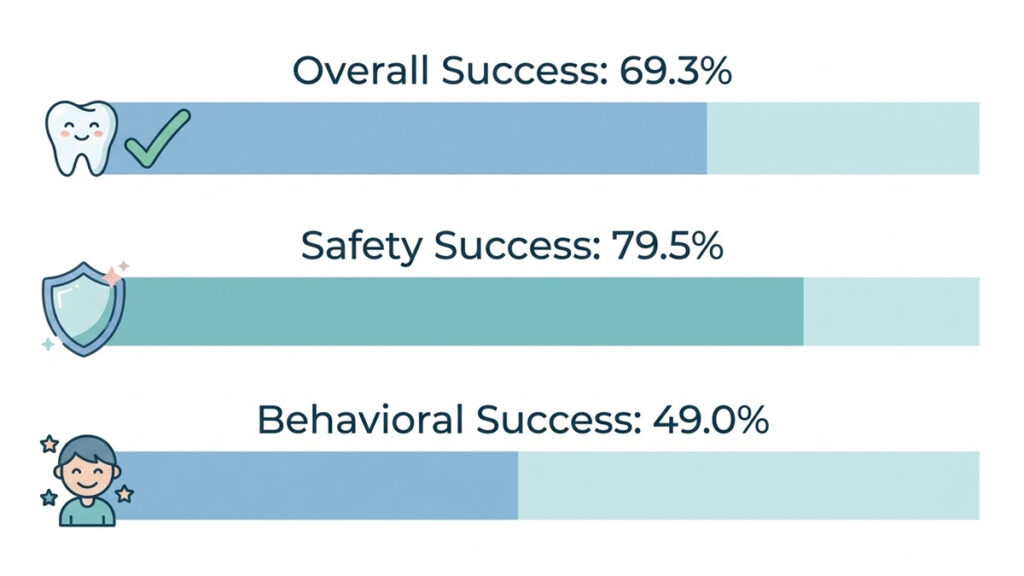
- What the study found: Overall sedation success: 69.3%. Behavioral success: 49.0%. Safety success: 79.5%. Treatment completion without general anesthesia: 62.1%.
- Who was studied: 824 children aged 24 to 60 months (2 to 5 years) receiving first-time dental sedation at Nationwide Children’s Hospital, 2015-2020.
- What predicted success: Older child age, male sex, calm behavior before sedation, and oral midazolam (versus intranasal midazolam).
- Who conducted it: Lead author Dr. Kristin D. Sweeney Marso, DMD, MS; researchers from Boston Children’s Hospital / Harvard School of Dental Medicine and Nationwide Children’s Hospital / Ohio State University. Published in Anesthesia Progress, Vol. 73, No. 1, 2026.
- What it does NOT mean: This study does not mean sedation is unsafe or that parents should refuse it; it means parents should ask specific questions before proceeding.
What the Study Actually Measured
The study, titled “Assessing Pediatric Sedation Using Patient-Centered Outcomes,” is a retrospective review of 824 children aged 24 to 60 months who underwent minimal to moderate sedation for dental treatment.
The researchers, led by Dr. Kristin D. Sweeney Marso of Boston Children’s Hospital and the Harvard School of Dental Medicine, used three separate outcome measures to define success rather than a single pass/fail metric.
This distinction matters, which is why the headline number (69.3%) does not capture the full picture parents need.
The three outcomes were defined as follows:
- Behavioral success: The child’s behavior during the procedure was manageable enough to complete treatment. Achieved in 49.0% of cases.
- Safety success: The procedure was completed without a significant adverse safety event. Achieved in 79.5% of cases.
- Treatment success: The planned dental treatment was completed without needing to escalate to general anesthesia. Achieved in 62.1% of cases.
Overall success, defined as meeting all three criteria, occurred in 69.3% of cases.
The study found that oral midazolam achieved higher success rates for both behavioral and safety outcomes compared to intranasal midazolam.
Additional predictors of overall success included older patient age, male sex, and cooperative behavior before sedation began.
Dr. Sweeney Marso stated: "The primary objective of this retrospective review of pediatric sedations was to assess overall sedation success as determined by behavior, safety, and treatment outcomes. In this sample, which included both single- and multi-drug sedations, older age, male sex, and cooperative presedation behavior predicted overall success."
What These Numbers Actually Mean for Parents
A 69.3% overall success rate sounds concerning at first, but context is essential before drawing conclusions.
First, this study examined minimal to moderate sedation only, not deep sedation or general anesthesia.
This is the lightest end of the sedation spectrum, typically used when a child’s dental anxiety or lack of cooperation makes standard treatment impractical, but the procedure does not warrant the full resources of an operating room.
These are also the youngest, most challenging dental patients, ages 2 to 5, during the window when cooperation is developmentally hardest to achieve.
Second, “unsuccessful” sedation in this context does not necessarily mean a dangerous outcome occurred.
The behavioral success rate of 49% means that roughly half of the children in this group behaved in a way that made the procedure technically challenging, not that 51% were harmed.
The safety success rate of 79.5%, the metric most directly related to physical well-being, is considerably higher than the overall success figure.
The researchers recommend further study to improve both patient selection and sedation protocols rather than suggesting sedation should be discontinued.
What the research does tell us clearly: the youngest children (ages 2 to 3) and those who showed anxious or uncooperative behavior before sedation began were less likely to have successful outcomes.
This information should be part of any pre-sedation conversation between a parent and a pediatric dentist or anesthesiologist.
If your child is 2 years old and already extremely anxious in the dental chair, the probability that minimal sedation alone will achieve a successful outcome is lower than the 69.3% overall figure suggests.
That is not a reason to panic; it is a reason to ask better questions and explore all alternatives.
Our guide to pediatric dental emergencies covers when sedation and urgent procedures are genuinely necessary versus when they can be deferred.
What Alternatives to Sedation Are Available?
Dental sedation is one tool in a range of behavior management options available to pediatric dentists.
The AAPD’s guidelines on behavior management recognize a spectrum of approaches, from non-pharmacological strategies to nitrous oxide to moderate sedation to general anesthesia.
Understanding the full range helps parents ask better questions and participate meaningfully in treatment decisions.
Tell-show-do: The most widely used behavior management technique in pediatric dentistry.
The dentist explains what will happen, demonstrates with instruments, and then performs the procedure.
For children with mild anxiety, this approach alone is often sufficient.
It requires a patient, experienced pediatric dentist, and a child who is at least minimally cooperative, but when it works, it avoids any pharmacological risk entirely.
Nitrous oxide (laughing gas): A mild inhalation sedative that reduces anxiety without causing unconsciousness.
Nitrous oxide has an excellent safety record in children, is rapidly reversible, and does not require an IV or injection.
It is appropriate for children who are anxious but not completely uncooperative.
Many procedures that might otherwise require oral sedation can be completed with nitrous oxide for children aged 3 and older who can breathe through a nasal mask.
Protective stabilization: Used selectively for young children who cannot cooperate due to their developmental stage, rather than anxiety.
The AAPD recognizes this as a legitimate technique when applied with parent consent and proper clinical judgment.
It is often more appropriate than pharmacological sedation for a 2-year-old who simply does not yet have the developmental capacity to understand or tolerate a dental procedure.
General anesthesia: For children with extensive dental needs, severe dental anxiety, significant medical conditions, or who are too young to cooperate with any other technique, general anesthesia in a hospital or surgical center setting is the most reliable option for completing complex treatment safely.
While general anesthesia carries its own considerations, it has a much higher procedure completion rate than minimal sedation for the most challenging pediatric cases.
Understanding when it is appropriate versus when it is overprescribed is part of the conversation parents should have with their child’s dental team.
To understand how dental anxiety develops and how to prevent it from escalating to the point where sedation is needed, see our guide to the first pediatric dental visit.
Questions to Ask Your Child’s Dentist Before Agreeing to Sedation
This study equips parents with specific data points to use in pre-sedation conversations.
Before agreeing to dental sedation for a child under age 5, consider asking the following:
1. Is sedation truly necessary, or are there non-pharmacological alternatives we have not tried?
Research shows that experienced pediatric dentists can complete many procedures on young children with behavioral guidance techniques alone.
If you are seeing a general dentist rather than a board-certified pediatric dentist, a second opinion from a pediatric dental specialist is worth considering.
2. What is your practice’s sedation success rate for children of my child’s age?
The new study’s 69.3% overall success rate is from a major children’s hospital with specialist-level expertise.
Practices with less sedation experience may have lower success rates. Ask your provider how many pediatric sedations they perform per year and what their outcomes data looks like.
3. What happens if the sedation is not successful?
If sedation fails to achieve the planned treatment, the child may need to return for another attempt or be referred for general anesthesia.
Understanding this pathway in advance helps parents plan and avoids surprise escalation of care.
4. Which sedation method are you recommending, and why?
The study found that oral midazolam outperformed intranasal midazolam for both behavioral and safety outcomes.
If intranasal delivery is being recommended, ask why oral administration is not being considered instead.
5. How will you assess my child’s pre-sedation anxiety level?
Since cooperative pre-sedation behavior predicted success in this study, ask how the team plans to assess and manage your child’s anxiety level before the procedure begins.
Strategies that reduce pre-procedure anxiety, including familiarization visits, child life specialists, and sedation-day preparation guidance, can meaningfully improve outcomes.
For parents managing ongoing dental anxiety in their children, our guide to cavities in children includes a section on how untreated anxiety leads to treatment avoidance and accelerated decay, and how addressing anxiety early breaks that cycle.
What This Means for Your Child By Age
Ages 2-3: The youngest children in this study had the lowest sedation success rates. For toddlers with significant dental needs, the decision between minimal sedation, nitrous oxide, protective stabilization, and general anesthesia should involve a board-certified pediatric dentist and, for complex needs, a pediatric anesthesiologist. The AAPD recommends that parents establish a dental home before the first birthday, specifically to build familiarity and reduce the likelihood that treatment in toddlerhood requires sedation at all.
Ages 4-5: Children at the older end of the study’s range had higher success rates. A 4 or 5-year-old with mild-to-moderate dental anxiety and a cooperative baseline is a good candidate for minimal sedation with oral midazolam, according to this study’s predictors. The key variable is pre-sedation behavior. A child who is already escalated into full panic before the procedure begins will be harder to manage, regardless of the sedation agent used.
All ages: Prevention remains the single most reliable way to avoid sedation decisions entirely. Children who visit a dentist from infancy, who have low cavity rates through diet and fluoride management, and who develop a positive association with dental visits almost never require sedation for routine care. The Queens pediatric dentist directory can help you find a provider who prioritizes prevention and behavioral guidance as first-line tools.
Frequently Asked Questions About Pediatric Dental Sedation
Is dental sedation safe for children under age 5?
Minimal to moderate sedation is generally considered safe when administered by properly trained clinicians in appropriate settings.
The new Anesthesia Progress study found a safety success rate of 79.5% across 824 cases at a major children’s hospital, meaning the vast majority of children in the study did not experience a significant adverse safety event.
As with any medical procedure, the risk-benefit analysis depends on the individual child, the dental need, the setting, and the provider’s experience.
Parents should ask their child’s dentist and anesthesiologist for a detailed discussion of risks before consenting.
What is oral midazolam, and why did it outperform intranasal midazolam?
Midazolam is a benzodiazepine medication commonly used for procedural sedation in children.
Oral midazolam is given by mouth (usually as a flavored syrup), while intranasal midazolam is administered through the nose.
The new study found oral delivery achieved better behavioral and safety outcomes than intranasal delivery in this pediatric dental population.
Researchers believe this may relate to differences in absorption rate, dosing predictability, and patient tolerance of the administration method.
Intranasal delivery can itself cause distress in young children, potentially worsening behavior before the sedative effect begins.
What should I do to prepare my child for dental sedation?
The study found that calm, cooperative pre-sedation behavior predicted overall success.
To maximize the chance of a positive outcome: follow all fasting instructions precisely, avoid communicating your own anxiety to your child, use simple positive language about the visit rather than detailed explanations of the procedure, and ask your dental team whether an anxiety-reducing familiarization visit before the sedation appointment is available.
Some practices offer child life specialists or pre-procedure preparation resources specifically designed to reduce pre-sedation anxiety.
What if dental sedation fails for my child?
If minimal or moderate sedation does not achieve the planned dental treatment, the most common next step is referral for treatment under general anesthesia in a hospital or surgical center setting.
While general anesthesia requires more preparation and carries its own considerations, it has a significantly higher procedure completion rate for children who cannot be adequately managed with lighter sedation techniques.
If this pathway is recommended for your child, ask for a referral to a pediatric dental specialist with hospital-based operating room privileges.
Medical disclaimer: This article is for informational purposes only and does not constitute medical or dental advice. Dental sedation decisions should always be made in consultation with a licensed pediatric dentist and, where appropriate, a board-certified pediatric anesthesiologist. Always discuss your child's individual health history, risk factors, and treatment alternatives with your child's dental care team before consenting to any sedation procedure.
Reviewed by the Pediatric Dentist in Queens Editorial Team. Last Updated: March 14, 2026.
SOURCE LIST
1. PRWeb / Anesthesia Progress — “Success of Minimal to Moderate Sedation in Pediatric Dentistry.” March 11, 2026. https://www.prweb.com/releases/success-of-minimal-to-moderate-sedation-in-pediatric-dentistry-302710587.html
2. Anesthesia Progress — Full study: “Assessing Pediatric Sedation Using Patient-Centered Outcomes.” Vol. 73, No. 1, 2026.
https://anesthesiaprogress.kglmeridian.com/(full text available)
Lead author: Kristin D. Sweeney Marso, DMD, MS — Boston Children’s Hospital / Harvard School of Dental Medicine
Co-institution: Nationwide Children’s Hospital / Ohio State University Study population: 824 children aged 24-60 months, first-time sedation, Nationwide Children’s Hospital, 2015-2020 Study type: Retrospective review

Mary – Queens Pediatric Dental Resource Manager. I’m a dental health researcher and parent advocate based in Queens, NY. After struggling to find reliable pediatric dental information during my own child’s dental emergency, I created this resource to help other Queens families navigate their children’s oral health needs.
I curate evidence-based information from leading pediatric dental organizations, peer-reviewed research, and trusted dental health experts. While I’m not a dentist, I’m committed to providing accurate, practical guidance that helps parents make informed decisions.
All content is thoroughly researched and includes proper medical disclaimers directing families to consult qualified pediatric dentists for their children’s specific needs.